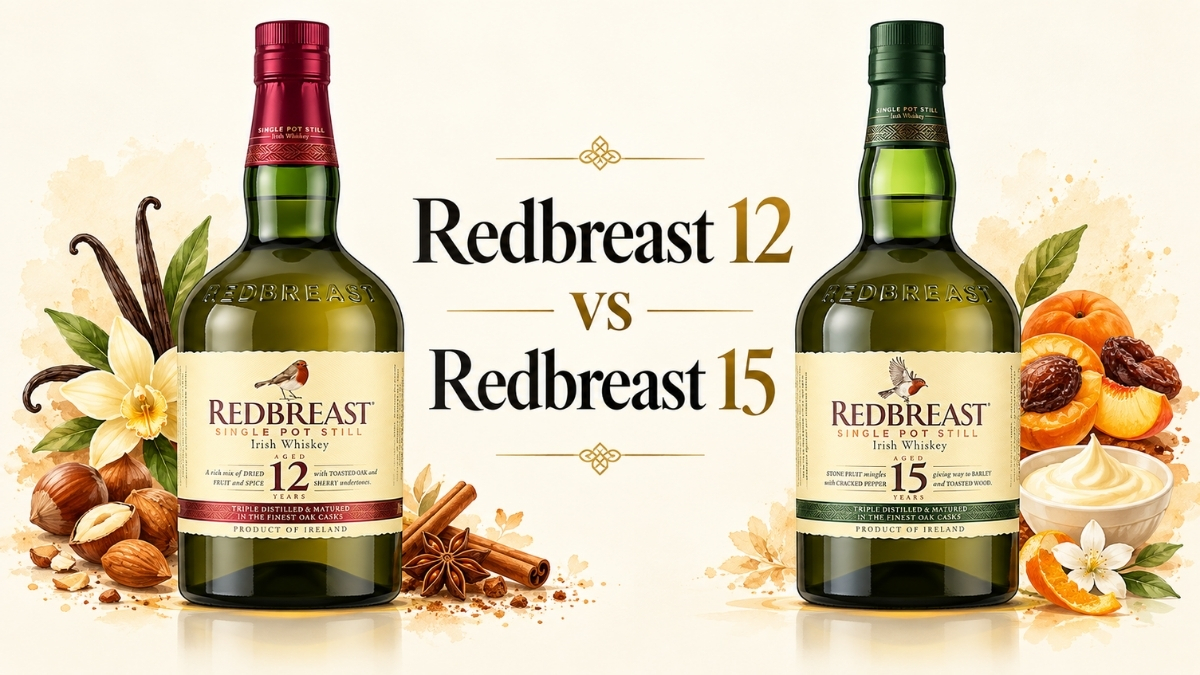
Redbreast 12 and Redbreast 15 are both age-stated Single Pot Still Irish Whiskeys from the same Redbreast family, made at Midleton in County Cork. The 15 has three more years in the cask and is bottled stronger, but older doesn’t automatically mean better, so the real question is whether those extra years produce a better whiskey or just a different one. Kaz has tasted both first-hand, and this comparison uses the same notes, scores and serve ratings as each bottle’s own Dram Verdict review — not age, price or reputation.
Quick Verdict
Choose Redbreast 15 if you want the better whiskey: it scores 4.8 against the 12’s 4.5, and in Kaz’s tasting it takes what works in the 12 and makes all of it richer, denser and more grown-up — more fruit (dried fruit with a touch of mango), more oak and a creamier, fuller body. It’s excellent neat, on the rocks and as a highball. Choose Redbreast 12 if you prefer a nuttier, more delicate style with a long, evolving finish, or you like your whiskey with water, where it’s the stronger of the two. It’s no consolation prize: it’s still Kaz’s favorite Irish whiskey.
Quick Comparison
| Redbreast 12 | Redbreast 15 | |
|---|---|---|
| Age | 12 years | 15 years |
| ABV | 40% (bottling reviewed) | 46% |
| Type | Tie (Single Pot Still Irish Whiskey) | |
| Casks | Bourbon and sherry | Bourbon and Oloroso sherry |
| Character | Nutty, Spiced, Vanilla | Rich, Fruity, Creamy |
| Sweetness | Tie (3 / 5) | |
| Fruit | 3 / 5 | 4 / 5 |
| Spice | Tie (3 / 5) | |
| Oak | 2 / 5 | 3 / 5 |
| Smoke / Peat | Tie (0 / 5) | |
| Body | 3 / 5 | 4 / 5 |
| With water | Very Good | Good |
| On the rocks | Tie (Excellent) | |
| Highball | Good | Excellent |
| Dram Verdict score | 4.5 | 4.8 |
Same sweetness, same spice, no smoke in either. Where they differ, the 15 rates higher — more fruit, more oak, more body — and the serve ratings split: the 12 is better with water, the 15 in a highball.
The Biggest Difference: Better, Not Just Older
In Kaz’s tasting, the extra years produce a better whiskey, not merely a different one — but the difference is one of depth, not of style. Kaz describes Redbreast 15 as taking what works in Redbreast 12 and making all of it denser and more grown-up: every element richer and more concentrated, with a light herbal note added, deeper fruit with a hint of mango, and a very creamy, oily texture. Redbreast 12 is the more delicate of the two — oily and complete, but nuttier, with malt and vanilla leading and a finish that keeps changing rather than fading. Neither is the bottle for a bold, punchy style.
The production facts are simpler than the tasting. Redbreast says the 15 is aged three years longer than the 12 and matured in a combination of bourbon and Oloroso sherry casks, and Pernod Ricard describes a careful balance of first-fill and refill casks; for the 12, Pernod Ricard says it’s matured in a combination of bourbon and sherry casks. Neither publishes the proportions. Those are facts about how the whiskeys are made — the differences in the glass described here come from Kaz’s tasting, not from the age statement or the cask list.
Nose
Redbreast 12 leads with nuts and dried fruit, then berries and a warm vanilla sweetness, with a light spice note underneath. Redbreast 15 is mature, settled and rich — vanilla, dried fruit, mango, herbs, floral notes, spice and oak. The 12’s nose is nuttier; the 15’s is fuller and more layered, with tropical fruit, herbs and oak alongside the vanilla.
Palate
Redbreast 12 is oily in texture, complex but delicate — malt and vanilla lead, with spice, ginger and apricot layered through and nuts returning underneath. Redbreast 15 is very creamy and oily, with vanilla, dried fruit, malt, mango, nuts, herbs, floral notes, spice and oak. Both share malt, vanilla, nuts and spice; the 15 is the creamier and denser of the two, while the 12 is more delicate, with ginger and apricot.
Finish
Redbreast 12 finishes slightly sweet and sour, turning woody and spicy, and lingers for a long time. Redbreast 15 finishes spicy and lightly bitter, with fruit and rich oak lingering in good measure. The 12’s finish is the one that moves the most; the 15’s carries more fruit and oak.
Which Is Sweeter?
Neither — both rate Sweetness 3 out of 5. Vanilla sweetness runs through both. In the 12 it sits with nuts, malt and a sweet-and-sour finish; in the 15 it comes wrapped in dried fruit and mango, so the 15 can read as the richer of the two even though it isn’t rated sweeter.
Flavor Profile Differences
Fruit: Redbreast 15 wins, 4 out of 5 against 3. Its fruit is deeper — dried fruit with a touch of mango. The 12 has dried fruit and berries on the nose and apricot on the palate.
Spice: a tie at 3. The 12 has a light spice note on the nose, ginger on the palate and a spicy finish. In the 15 the pot still spice is clearly there but never prickles.
Oak: Redbreast 15 wins, 3 against 2. Oak shows on the 15’s nose and palate and it finishes with rich oak; in the 12, wood comes through mainly as the finish turns woody and spicy.
Smoke / Peat: a tie at 0. Kaz found no smoke or peat in either.
Body: Redbreast 15 wins, 4 against 3. The 15 is very creamy and oily; the 12 is oily and substantial without ever feeling heavy, but more delicate.
Which Is Better Neat?
Redbreast 15. Dram Verdict scores are judged neat and reflect only what’s in the glass — not price, age statement, prestige or whether a retailer link exists. Redbreast 12 earns a 4.5: one of the most complete, well-balanced whiskeys Kaz has had, with an oily texture and a long finish that moves from sweet to woody and spicy, and it remains Kaz’s favorite Irish whiskey. Redbreast 15 goes further and scores 4.8: rich, complete and very well balanced, with sherry and bourbon cask character in harmony, deeper fruit and a creamier texture, and spice that never turns prickly. Neither review found a real weakness neat. The 0.3 gap is clear but not dramatic — this is a very good whiskey against an even better one.
Strength doesn’t explain it. The 15 is bottled at 46% against the 40% of the 12 Kaz reviewed, but its fuller body and richer palate are what Kaz tasted, not something to read off the label.
Which Is Better With Water?
Redbreast 12 — rated Very Good with water against the 15’s Good. With water the 12’s flavor doesn’t lose definition and its aroma opens up nicely. Twice up, the 15 turns sweet and fruity without its body thinning out, and the spice eases slightly; a smaller splash brings out more sweetness than a full 1:1 pour. It’s enjoyable, but Kaz rates it a lower priority than the 15’s other serves.
Which Is Better On the Rocks?
A tie — both are rated Excellent over ice. The 12’s sweetness settles, spice comes forward and the mouthfeel gets even creamier. The 15 gains sweetness and depth, and as it dilutes oak, spice and a little bitterness come through — not negatively, but as a classic character with a faint old-bottle feel.
Which Makes the Better Highball?
Redbreast 15 — rated Excellent against the 12’s Good. The 15 is rich and settled rather than bright, which seems at odds with what you’d want from a highball, yet after a clean, easy sip it leaves a complex, full finish, and every mouthful is very satisfying. The 12 works fine as a highball, but Kaz doesn’t see it as the bottle for that job: a lighter whiskey serves refreshment better.
Value
Redbreast 15’s review rates its value Fair; Redbreast 12’s value isn’t rated, so this comparison doesn’t name a value winner. Prices change by market and over time, and price plays no part in either score — the 4.5 and 4.8 reflect what’s in the glass only. Each review page lists current retailer options if you want to compare prices where you live.
Redbreast 12 vs Redbreast 15: Which Should You Buy?
Buy Redbreast 12 if you want a nuttier, more delicate pot still whiskey with malt, vanilla, ginger and apricot; you love a long finish that keeps changing; you’re new to Single Pot Still — it’s one of the first bottles Kaz would point you toward; or you like to add water, where it’s the stronger of the two. For another pot still comparison, see Redbreast 12 vs Green Spot.
Buy Redbreast 15 if you want the richest, most complete version of the Redbreast style — deeper fruit with a hint of mango, more oak, and a very creamy, oily body; you mostly drink neat; or you want one bottle that’s excellent neat, on the rocks and as a highball. It isn’t flashy, though: its strength is refinement, not punch.
Overall: buy Redbreast 15. It scores 4.8 against the 12’s 4.5, it’s the better whiskey neat, and in Kaz’s tasting it’s every part of the 12 made richer and more concentrated, with a creamier body and more fruit and oak — excellent on the rocks and as a highball too. Redbreast 12 is still an outstanding whiskey and Kaz’s favorite Irish whiskey: choose it if you prefer a nuttier, more delicate style or you like your whiskey with water. Browse the Single Pot Still archive for more first-hand reviews.
- Is Redbreast 15 better than Redbreast 12?
-
Yes — Redbreast 15 scores 4.8 against Redbreast 12’s 4.5. In Kaz’s tasting it’s richer, creamier and more concentrated, with more fruit and oak. The 12 is still excellent and the better choice with water.
- Is Redbreast 15 better just because it’s older?
-
No. Dram Verdict scores ignore age statements. The 15 scores higher because of what Kaz tasted — deeper fruit, more oak and a creamier body — not because it spent three more years in the cask.
- Which is sweeter, Redbreast 12 or Redbreast 15?
-
Neither — both rate Sweetness 3 out of 5. The 15 rates higher on Fruit, Oak and Body.
- Which is better neat, Redbreast 12 or Redbreast 15?
-
Redbreast 15, which scores 4.8 against 4.5. The 12 is complete and well balanced neat; the 15 is richer and creamier, with spice that never prickles.
- Which is better with water, Redbreast 12 or Redbreast 15?
-
Redbreast 12 — rated Very Good with water against the 15’s Good. Water opens up the 12’s aroma without blurring its flavor.
- Are Redbreast 12 and Redbreast 15 matured in the same casks?
-
Both are matured in a combination of bourbon and sherry casks; Redbreast specifies Oloroso sherry casks for the 15, which is aged three years longer. Neither publishes the cask proportions.