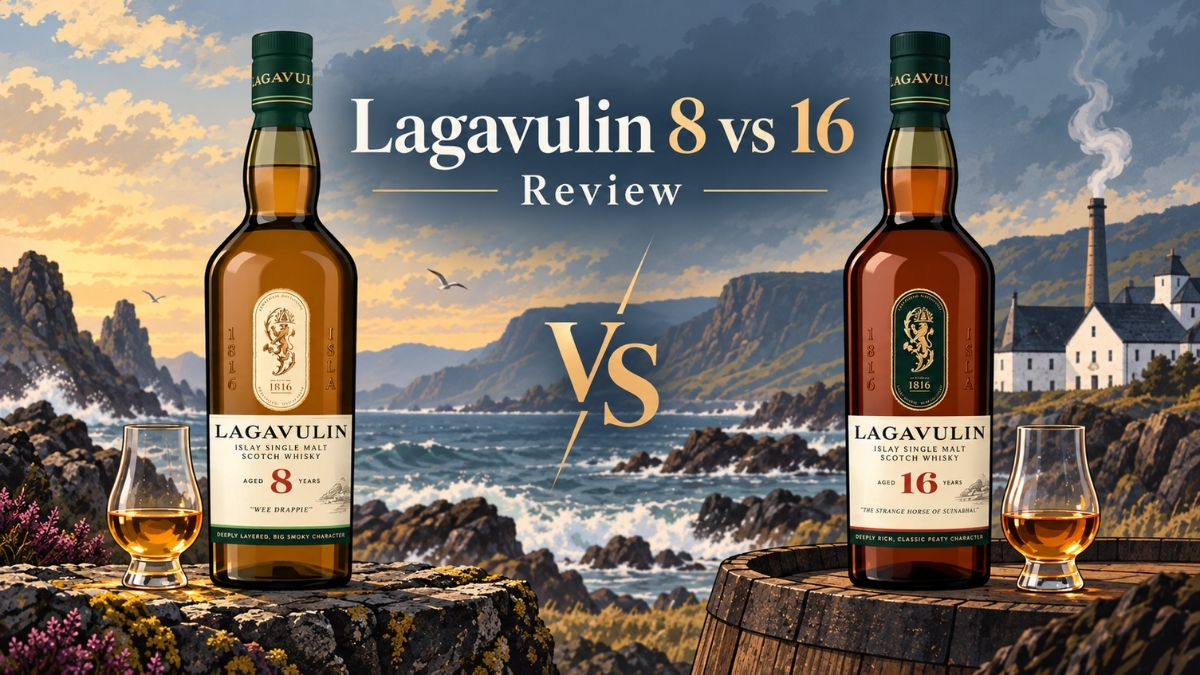
Lagavulin 8 and Lagavulin 16 come from the same Islay distillery and share the same peat-forward DNA, but they are not the same whisky wearing two age statements. Having tasted both in separate sessions, the short answer is this: Lagavulin 16 Year Old is the more complete, more complex sipping whisky and the one most people should reach for if they only ever buy one Lagavulin. Lagavulin 8 Year Old isn’t a cut-price stand-in for it — it’s a fresher, punchier, more overtly smoky expression that actually beats the 16 in a couple of real, measurable ways.
If you already know you love aggressive Islay peat and want something that leans into it rather than rounding it off, the 8 has a real case. If you want the fuller, more layered, more “finished” version of Lagavulin’s house style, the 16 remains the benchmark. This comparison breaks down exactly where each one wins, using first-hand tasting notes and serve-by-serve evidence rather than specs alone.
Quick Comparison
| Lagavulin 8 Year Old | Lagavulin 16 Year Old | |
|---|---|---|
| Age | 8 years | 16 years |
| ABV | 48% | 43% |
| Style | Youthful, punchy, smoke-forward | Mature, rich, integrated |
| Smoke intensity | Very high | High |
| Body | Lighter than the proof suggests | Full, oily |
| Complexity | Direct, straightforward | Genuinely layered |
| Best neat | ✓ | |
| Best with water | ✓ | |
| Best on the rocks | ✓ | |
| Best highball | ✓ | |
| More approachable | ✓ | |
| Best for peat lovers | ✓ | |
| Dram Verdict score | 4.3 | 4.9 |
| Value | Depends on price gap and drinking style | |
| Overall pick | Lagavulin 16 | |
A few of those rows are close calls and are explained in more detail below — this table is a starting point, not the whole argument.
Taste Comparison
Both are unmistakably Lagavulin — the smoke, the maritime edge, the underlying sweetness are all there in both glasses. What changes is the balance between them, and how settled that balance feels.
Nose
The 8 comes across as youthful and immediate — vanilla, apple and malt sit alongside real smoked-food aroma, a faint medicinal edge, leather and a distinct maritime saltiness, with the smoke reading as genuinely intense right out of the glass. The 16 is rich and composed rather than sharp: caramel and nuts against sulfur and medicinal notes, with a smokiness that’s powerful yet restrained, plus fragrant wood, herbs, spice and sea salt. The difference isn’t really about which has more going on — it’s that the 8’s smoke announces itself first, while the 16’s smoke sits inside a more settled, layered aroma from the start.
Palate
On the palate, the 8 is very punchy, with an oily texture, vanilla and herbs meeting malt and smoked-food character, plus nuts, a touch of lemon, chocolate, sea salt and spice — all wrapped around a genuinely intense hit of smoke. The 16 keeps the same balance of power and restraint it shows on the nose: also oily, but more complex overall, with honey and nuts meeting soy sauce and medicinal notes, dark chocolate, spice, brine and oak, and the smoke running through all of it rather than sitting on top. This is where the age gap actually shows up in the glass — the 16 reads as more developed and layered, while the 8 reads as more direct and single-minded about its smoke.
Finish
Both finish long, but differently. The 8’s finish carries spice and smoke together. The 16’s finish carries toasty oak and a steady, unhurried smokiness. Length isn’t really the differentiator here — it’s that the 16’s finish feels more settled and oak-driven, while the 8’s stays more actively smoky and spicy to the end.
Smoke and Peat
This is the clearest, most important difference between the two. On Dram Verdict’s Flavor Profile, the 8 rates a 5 for Smoke/Peat against the 16’s 4 — and that’s not a rounding error. The 8’s smoke is genuinely more overt and forceful: it announces itself immediately on the nose and stays out front on the palate. The 16’s smoke, while still very much present and unmistakably Lagavulin, is more integrated — woven into the honey, chocolate and oak rather than sitting on top of them.
More smoke intensity doesn’t automatically mean a “better” peat whisky — it means a different kind of peat experience. The 8 is the one to reach for if you want that smoke to be the main event. The 16 is the one to reach for if you want smoke as one voice in a more complex arrangement rather than the loudest one in the room.
Body and Texture
This is genuinely the 8’s weak point, and it’s worth being upfront about it rather than glossing over it: for a whisky bottled at 48% ABV, its body doesn’t feel as full or weighty as the proof and the forceful smoke suggest. It’s oily in texture and satisfying, but not truly substantial — there’s a real gap between how intense it smells and tastes and how much weight actually sits behind it.
The 16, even at a lower 43% ABV, is fuller — genuinely oily, rich and full-bodied, with real weight behind the complexity rather than just around it. On body alone, the 16 wins clearly, and it’s one of the main reasons the two whiskies don’t feel interchangeable despite sharing a distillery.
Complexity and Maturity
Sixteen years in cask doesn’t automatically make a whisky more complex — but in this case, the tasting evidence backs it up rather than just the age statement. The 16 is described in its own review as “genuinely complex” with real depth that rewards sitting with it, where honey, dark chocolate, iodine, brine and toasted oak all show up as distinct, developed layers. The 8 is more straightforward: intense and well-defined, but built around fewer, more direct notes rather than a long list of interacting ones.
Neither read is a knock on the 8 — youthful and direct is a legitimate style, not an unfinished version of complex. But if complexity specifically is what you’re shopping for, the 16 clearly delivers more of it.
Which Is Better Neat?
The 16, and it isn’t especially close. Neat is where its extra maturation pays off most directly — the balance of power and restraint, the full body, the layered sweetness and smoke all come together into what its own review calls “close to definitive” for the style, with no notable liquid-level weakness. The 8 is genuinely enjoyable neat and its intensity is real, but the body shortfall discussed above is most noticeable in this serve, where there’s nothing else to fill it out.
Which Is Better With Water?
The 16 again, rated Very Good against the 8’s Fair — though it’s worth noting these ratings come from slightly different water-serve styles for each bottle (a more diluted mizuwari-style pour for the 16 versus a 1:1 twice-up pour for the 8), so this isn’t a perfectly apples-to-apples comparison. On the 8, a small amount of water brings out more fruitiness and softer sweetness within the smoke, but the profile blurs somewhat rather than sharpening, and a light touch tends to bring out more spice than clarity. On the 16, water brings out deep sweetness and toastiness and lets the smoke fold into the rest of the flavor rather than fighting it, with a rich, lingering finish. Water is more clearly a net positive for the 16 than for the 8.
Which Is Better On the Rocks?
Here the 8 wins. Rated Very Good against the 16’s Good, ice suits the 8 nicely — it turns into a refreshing, clean way to drink it, with sweetness pulling back and the profile turning notably dry. A slight bitterness can emerge, which won’t be for everyone, but it stays enjoyable through the dilution. On the 16, the rocks pull the sweetness back and bring oak forward into a drier, more austere version of the whisky — good if you like that profile, but a genuinely different, less immediately appealing experience than neat.
Which Makes the Better Highball?
The 8, and this might be its single strongest advantage. Rated Excellent, it makes a genuinely well-balanced highball — the smoke stays weighty rather than disappearing, the mouthfeel turns creamy, and a faint sweetness plus a touch of acidity keep the whole thing feeling fresh. The 16’s highball is rated Very Good, but its own review notes that the richness is largely lost in the mix, leaving something slightly sweet and elegant but missing most of what makes it special neat. Don’t assume the more expensive, more complex bottle automatically makes the better mixed drink — here, the opposite is true.
Which Is More Approachable for Someone Newer to Peated Scotch?
Neither bottle is an especially gentle introduction to peated Scotch, full stop — both are serious, peat-forward Islay malts, and the 16’s own review is explicit that it “won’t convert anyone who simply doesn’t like peat.” Between the two, though, the 16 is the more approachable one: its smoke, alcohol and richer flavors feel more integrated and composed, folded into a rounder overall profile. The 8 is more immediate, sharper and more confrontational right out of the gate. If you’re curious about heavily peated Scotch for the first time, the 16 gives you a more composed picture of why people love the style; the 8 throws you straight into its most intense element.
Which Is Better for Peat Lovers?
The 8 has a real case here. If you already know you like heavily peated whisky — Laphroaig 10 or Ardbeg 10 territory — the 8’s more overt, punchier smoke delivers exactly that hit in a way the more settled 16 doesn’t try to. It’s also a genuinely different experience from the 16 rather than a lesser version of it, which makes it worth owning alongside the 16 rather than instead of it, for drinkers who specifically chase peat intensity.
Value
Value here is judged separately from quality — it doesn’t move either bottle’s Dram Verdict Score, and there’s no universal Value winner between them. It depends on your local price gap and how you actually drink it. As a rough US-market snapshot at the time of writing, the 8 tends to sell for somewhat less than the 16, with prices having drifted upward over time for both — but this varies by retailer and region, and shouldn’t be read as a fixed or global price point for either bottle. Neither currently carries an “Excellent value” rating on Dram Verdict; both are rated Fair for the price.
As a practical guide rather than a hard rule: if the gap where you’re buying is fairly small, roughly $15–20, the 16’s extra body and complexity are generally worth paying for if you’re drinking mostly neat. Once the gap gets wider — roughly $25–30 or more — the 8’s own strong scoring starts to look like the more sensible buy on price alone. And if you mainly drink on the rocks or as a highball rather than neat, the 8 can be the better buy even when the gap is small, since it wins both of those serves outright regardless of price.
Lagavulin 8 vs 16: Which Should You Buy?
Buy Lagavulin 8 if you want a fresher, punchier, more overtly smoky Islay whisky; you already know you like intense peat in the Laphroaig 10 / Ardbeg 10 range; or you plan to drink it mostly on the rocks or as a highball, where it genuinely outperforms the 16.
Buy Lagavulin 16 if you want the richer, more complex, more complete sipping whisky; you’re drinking it mostly neat; or you want the more classic, benchmark version of Lagavulin’s house style.
Overall pick: Lagavulin 16. This isn’t about age or prestige — it’s that the 16 is the more complete, more versatile whisky neat, which is how most people drink most of their whisky, and it does so with no notable liquid-level weakness. The 8 isn’t a lesser whisky, though, and it isn’t just a younger 16: it’s a genuinely different style with real wins of its own, and drinkers who specifically want maximum smoke or a better mixed-drink base have good reason to reach for it instead.
- Is Lagavulin 8 smokier than Lagavulin 16?
-
Yes, by rating — the 8 scores 5 for Smoke/Peat against the 16’s 4 on Dram Verdict’s Flavor Profile. In practice, the 8’s smoke is more overt and reads earlier and louder in the glass, while the 16’s smoke is still very present but more woven into a richer overall profile.
- Is Lagavulin 8 just a younger version of Lagavulin 16?
-
No. It shares the distillery’s peat character, but it’s a genuinely different expression rather than a scaled-down 16 — fresher, punchier and more smoke-forward, with a lighter body and a more direct, less layered flavor profile.
- Which is more approachable for someone newer to peated Scotch?
-
The 16 is the more approachable of the two, though neither is an especially gentle introduction to peated Scotch. Its smoke, alcohol and richer flavors feel more integrated into a rounder overall profile, while the 8’s smoke is more immediate and confrontational right from the first sip.
- Which makes a better highball, Lagavulin 8 or 16?
-
Lagavulin 8, rated Excellent against the 16’s Very Good. The 8 keeps its smoke and freshness intact when mixed with soda, while the 16 loses much of the richness that makes it special neat.
- Is Lagavulin 8 better value than Lagavulin 16?
-
There’s no universal answer — it depends on the price gap where you’re buying and how you drink it. At a small gap, the 16 tends to justify the premium for mostly-neat drinkers; at a wider gap, or if you mainly drink on the rocks or as a highball, the 8 becomes the more sensible buy. Neither bottle currently carries an “Excellent value” rating on Dram Verdict — both are rated Fair for the price.
Where to Buy
Lagavulin 8 Year Old
United Kingdom
Check Current Priceat The Whisky ExchangeLagavulin 16 Year Old
United Kingdom
Check Current Priceat The Whisky Exchange
We may earn a commission if you buy through our links. This never affects our scores.



Comments