
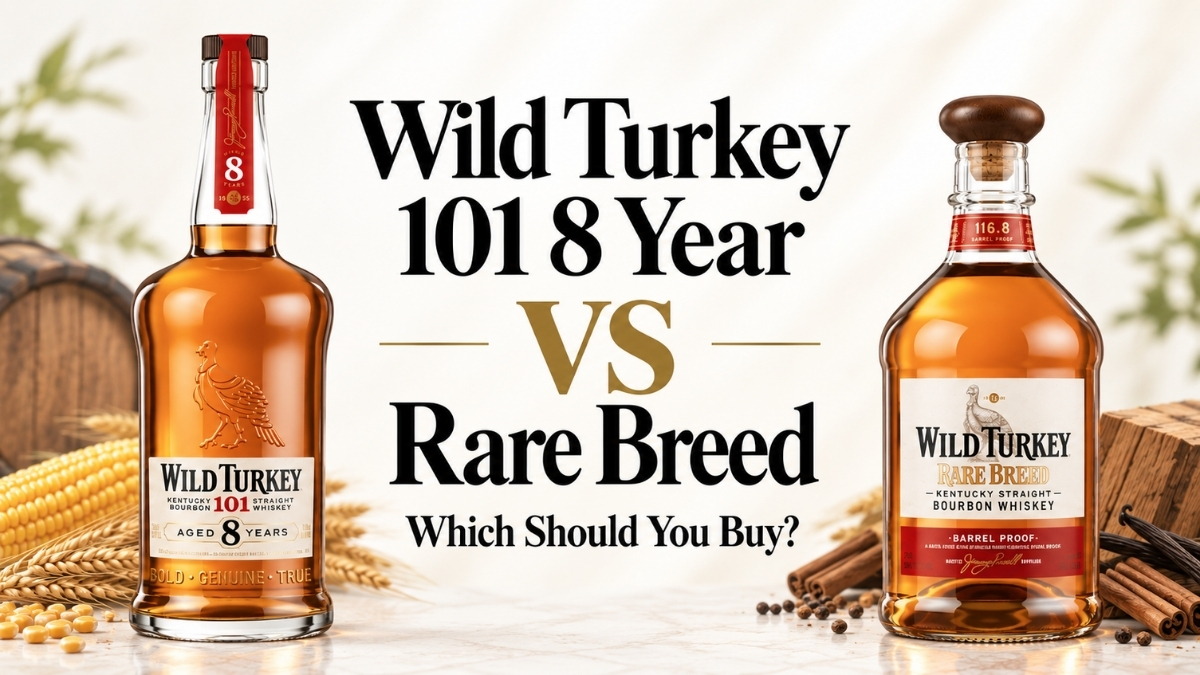
Wild Turkey 101 8 Year and Wild Turkey Rare Breed are both bold, spice-forward bourbons from the same Kentucky distillery, but they get there in different ways. This comparison covers the age-stated Wild Turkey 101 8 Year — not the standard, no-age-statement Wild Turkey 101 — bottled at 101 proof (50.5% ABV) with an explicit 8-year age statement. Wild Turkey Rare Breed, by contrast, is a full barrel-proof release at 116.8 proof (58.4% ABV), blended from 6-, 8- and 12-year-old stocks rather than carrying a single age statement of its own. Dram Verdict has tasted both bottles first-hand, and this comparison is built entirely on that tasting rather than on specs or reputation.
Quick Verdict
Choose Wild Turkey 101 8 Year if you want the spicier of the two on Dram Verdict’s own Flavor Profile, you want a bourbon that also makes a genuinely excellent highball, and you’re able to track one down — official US availability is limited right now. Choose Rare Breed if you want true barrel-proof strength at a bottle you can reliably find on a US retailer’s shelf, and you don’t mind a very slightly milder spice profile in exchange for that availability. The sections below break down exactly where each one wins, using Dram Verdict’s own first-hand tasting rather than specs or reputation.
Quick Comparison
| Wild Turkey 101 8 Year | Wild Turkey Rare Breed | |
|---|---|---|
| Age | 8 years (minimum) | No age statement (blend of 6-, 8- and 12-year-old stocks) |
| ABV | 50.5% (101 proof) | 58.4% (116.8 proof, barrel proof) |
| Character | Tie (Spicy, Oaky, Full-bodied) | |
| Style | Age-stated, rye-spiced, 101-proof | Barrel-proof, batch-blended, standing release |
| Sweetness | Tie (3 / 5) | |
| Fruit | Tie (2 / 5) | |
| Spice | 5 / 5 | 4 / 5 |
| Oak | Tie (4 / 5) | |
| Smoke / Peat | Tie (0 / 5) | |
| Body | Tie (4 / 5) | |
| Best neat | Tie | |
| Best with water | Tie | |
| Best on the rocks | Tie | |
| Best highball | ✓ | |
| Typical price | Limited US availability; ~¥3,300 (~$21) in Japan | ~$55–$65 (US) |
| Dram Verdict score | Tie (4.3) | |
| Value | Tie (Excellent) | |
Five of six Flavor Profile axes are a genuine tie, and both bottles carry the same overall Dram Verdict Score. The real differences are narrower than the proof gap suggests — spice intensity, highball performance, and which one you can actually buy right now.
The Biggest Difference: Proof and Age Recipe vs. What’s Actually in the Glass
On paper, these two bourbons are built differently. Wild Turkey 101 8 Year carries a straightforward 8-year age statement and is bottled at 101 proof (50.5% ABV). Wild Turkey Rare Breed carries no single age statement at all — it’s a barrel-proof blend of 6-, 8- and 12-year-old stocks, bottled at 116.8 proof (58.4% ABV) with no water added after distillation. On specs alone, Rare Breed is both older on average and considerably higher proof.
That doesn’t carry over cleanly into the glass. On Dram Verdict’s own Flavor Profile, the two tie on sweetness, fruit, oak, smoke and body — five of six axes are identical. The one real difference is spice, and it runs opposite to what the proof gap would suggest: Wild Turkey 101 8 Year rates higher (5 out of 5) than the higher-proof Rare Breed (4 out of 5). Both Reviews also independently describe their alcohol as unusually well-integrated for their own strength — neither drinks hot or rough at its own proof. A higher proof and an older average age don’t automatically add up to more intensity in this pair; what actually separates them in the tasting is narrower and more specific than the spec sheet implies.
Nose
Wild Turkey 101 8 Year’s nose is powerful and concentrated right away — vanilla and caramel sweetness backed by real spice and oak, with a faint nail-polish-like sharpness that fades quickly. Rare Breed’s nose shows a touch of alcohol presence, as expected at 58.4% ABV, but it doesn’t get in the way of a firm, sweet aroma underneath — maple syrup, vanilla and orange, backed by spice and oak. Both lead with a similar vanilla-oak-spice core; 101 8 Year’s reads as the more immediately concentrated of the two, while Rare Breed’s carries a touch more fruit alongside its alcohol presence.
Palate
101 8 Year is big, rich and concentrated on the palate — vanilla and dark cherry sweetness meet a genuinely powerful hit of rye spice, with herbs, toasted nuts, orange peel, a touch of bitterness and a medicinal edge underneath. Rare Breed is powerful and spicy with real punch — vanilla and caramel sweetness up front, then nuts, herbs, spice and oak build through the middle. Both hold together at their own proof rather than turning hot or one-note; 101 8 Year’s spice reads as the more forceful of the two, matching its higher Spice rating.
Finish
101 8 Year’s finish is long, with powerful spice and a lingering bitterness carried by the same deep oak character throughout. Rare Breed’s finish is also long, with sweetness, spice and oak carrying on together — no single element overstays the others. Both finish long and spice-forward; 101 8 Year leans slightly more toward bitterness and oak at the very end, while Rare Breed stays a touch more balanced between its three main elements.
Which Is Spicier?
Wild Turkey 101 8 Year, by Dram Verdict’s own Flavor Profile — 5 out of 5 on Spice against Rare Breed’s 4 out of 5. This is a tasting-based finding, not a proof-based assumption: Rare Breed is the higher-proof bottle of the two (116.8 proof against 101), but that extra strength doesn’t translate into extra perceived spice in the tasting. 101 8 Year’s rye-driven spice, matured under the brand’s maximum “Alligator Char” barrel treatment, is simply the more forceful of the two in the glass.
Which Has More Body?
Neither — this is a genuine tie. Both bottles carry a Body rating of 4 out of 5 on Dram Verdict’s Flavor Profile, and both Reviews independently describe a full, substantial mouthfeel. Rare Breed’s significantly higher proof doesn’t translate into a heavier-feeling pour than 101 8 Year’s.
Which Feels Hotter?
Neither, in practice. Rare Breed is bottled nearly 16 points higher in proof (116.8 against 101), but Dram Verdict’s tasting of both bottles found the alcohol unusually well-integrated in each case — 101 8 Year “doesn’t drink hot or rough” at 50.5% ABV, and Rare Breed likewise “doesn’t turn hot or one-note” at 58.4% ABV. The proof numbers alone would suggest Rare Breed should feel more aggressive, but that isn’t how it plays out in the glass for either bottle.
Which Is Better Neat?
This is genuinely a tie — both bottles carry the same 4.3 Dram Verdict Score, and neither Review found a liquid-level flaw in the other’s neat pour. If you’re choosing purely on which tastes more accomplished neat, the honest answer is that both deliver at the same level, just in slightly different directions: 101 8 Year leans spicier, Rare Breed leans very slightly milder despite its higher proof.
Which Is Better With Water?
Another tie — both are rated Good with a splash of water. 101 8 Year’s water note describes more sweetness and fruit coming forward without thinning the body. Rare Breed’s water note describes some of the heft coming off while the flavor stays genuinely delicious, with sweetness stepping forward as the spice is tamed. Both reward a light touch rather than a heavy pour.
Which Is Better On the Rocks?
Another tie — both are rated Excellent over ice, and it’s a standout serve for both bottles. 101 8 Year’s ice serve brings out melon and dark cherry sweetness balanced against the spice. Rare Breed’s ice serve is described as where it shines, with sweetness building strongly as the alcohol heat and spice both soften, staying enjoyable as it dilutes further. If you mainly drink bourbon on the rocks, either bottle performs at its best there.
Which Makes the Better Highball?
Wild Turkey 101 8 Year, clearly — rated Excellent against Rare Breed’s Fair, one of the more decisive differences in this comparison. 101 8 Year’s highball note describes a rich but genuinely clean-drinking combination of bitterness, spice and light acidity. Rare Breed’s own note is candid about the trade-off: the oak turns heavy and the high proof gives it a weightier mouthfeel than most highballs call for. If a whiskey highball is your main use case, 101 8 Year is the more natural fit of the two.
Value
Both bottles carry an “excellent value” rating on their individual Reviews, but the reasoning — and the practical buying picture — is different for each. Wild Turkey Rare Breed is a standing part of Wild Turkey’s regular lineup, typically found in the $55–$65 range at US retailers, which is genuinely inexpensive for a true barrel-proof bourbon of this quality. Wild Turkey 101 8 Year’s value case is harder to pin to a single US price: as of its Review, Wild Turkey’s own site lists it as no longer available, and it’s sold more consistently in Japan, where Dram Verdict’s own reference price (around ¥3,300, roughly $21) makes it an excellent deal — a case that gets meaningfully weaker above about ¥5,000 (roughly $32). If you’re shopping in the US specifically, Rare Breed is the more straightforward value proposition simply because it’s the one you can reliably buy at a known price; if you can find 101 8 Year at a reasonable price, including through Japan or secondary/import listings, its excellent-value case holds up just as well.
Wild Turkey 101 8 Year vs Rare Breed: Which Should You Buy?
Buy Wild Turkey 101 8 Year if you want the spicier of the two on Dram Verdict’s own Flavor Profile; you want a bourbon that also makes a genuinely excellent highball; or you’re able to track one down, whether through US secondary/import listings or in Japan, where it’s the brand’s flagship bottling.
Buy Wild Turkey Rare Breed if you want true barrel-proof strength at a bottle you can reliably find on a US retailer’s shelf; you’re comfortable with a very slightly milder spice profile in exchange for that availability; or you don’t plan to make highballs with it, since that’s where it performs the weakest of the two.
Overall: these two bourbons are closer than their proof numbers suggest. They tie on Dram Verdict’s overall Score (4.3 each) and on five of six Flavor Profile axes, tie on neat, water and rocks performance, and both carry an “excellent value” rating on their own terms. The real differences are narrow but real: 101 8 Year is spicier and clearly better in a highball; Rare Breed is the higher-proof bottle and, for most US-based buyers today, the far easier one to actually purchase. If you can find both at a fair price, this comes down to spice preference and serving style. If you can only reliably find one, availability will likely make the decision for you.
For more on what “barrel proof” actually means, see Dram Verdict’s guide to barrel proof vs cask strength, or browse the full Bourbon archive for more first-hand reviews in this category.
- Is Wild Turkey Rare Breed stronger than Wild Turkey 101 8 Year?
-
Yes, in proof — Rare Breed is bottled at 116.8 proof (58.4% ABV) against 101 8 Year’s 101 proof (50.5% ABV). But by Dram Verdict’s own tasting, 101 8 Year is actually the spicier of the two, so the higher proof doesn’t mean more intense in every sense.
- Is Wild Turkey Rare Breed a 12-year bourbon?
-
No. Rare Breed carries no single age statement — it’s officially a blend of 6-, 8- and 12-year-old stocks, not a straight 12-year-old bourbon.
- Is Wild Turkey 101 8 Year the same as regular Wild Turkey 101?
-
No. They share a name and a proof, but Wild Turkey 101 8 Year carries an explicit 8-year age statement that the standard, no-age-statement Wild Turkey 101 does not.
- Which is spicier, Wild Turkey 101 8 Year or Rare Breed?
-
Wild Turkey 101 8 Year, by Dram Verdict’s own Flavor Profile — 5 out of 5 on Spice against Rare Breed’s 4 out of 5, despite being the lower-proof bottle of the two.
- Which makes a better highball, Wild Turkey 101 8 Year or Rare Breed?
-
Wild Turkey 101 8 Year, rated Excellent against Rare Breed’s Fair. Rare Breed’s own tasting notes are candid that its oak and high proof make it a heavier fit for a soda-based drink.
- Which is easier to find in the US, Wild Turkey 101 8 Year or Rare Breed?
-
Rare Breed. It’s a standing part of Wild Turkey’s regular US lineup, while Wild Turkey 101 8 Year is listed as no longer available on Wild Turkey’s own site and shows as backordered at several US retailers.

Comments