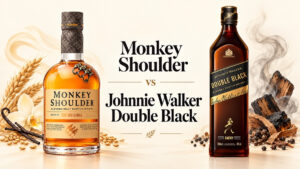
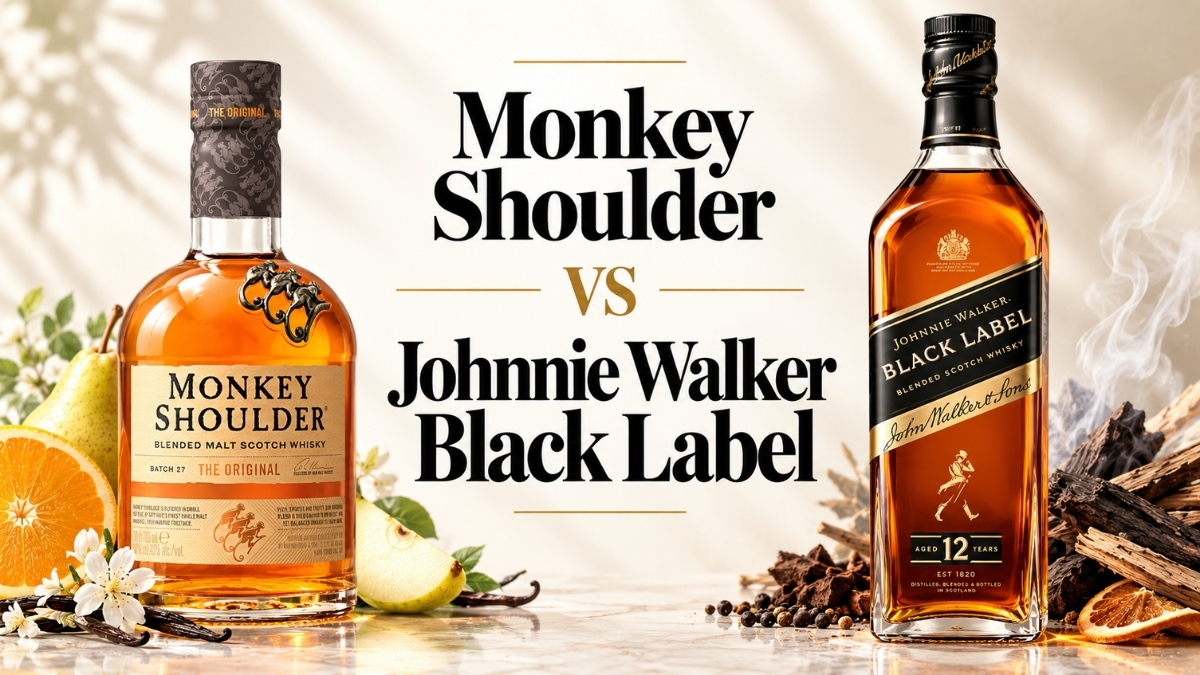
Monkey Shoulder and Johnnie Walker Black Label 12 sit at the same price on US shelves, but they aren’t the same kind of Scotch. Monkey Shoulder is a blended malt — made only from malt whisky, with no age statement — while Black Label is a blended Scotch of malt and grain whiskies with a 12-year age statement. Kaz has tasted both first-hand, and this comparison is built on that tasting: the same notes, scores and serve ratings behind each bottle’s own Dram Verdict review.
Quick Verdict
Choose Black Label 12 if you’ll drink it neat or over ice: in Kaz’s tasting it’s the more complete whisky, with more sweetness, fruit, spice, smoke and body, and it scores higher (4.2 against 3.6). Choose Monkey Shoulder if you want a mellow, creamy, vanilla-led Scotch for highballs and mixed drinks, where it genuinely shines. Both make an excellent highball — the difference there is style, not quality — and both make a good cocktail base: Black Label adds more depth, Monkey Shoulder blends in more smoothly.
Quick Comparison
| Monkey Shoulder | Black Label 12 | |
|---|---|---|
| Type | Blended malt Scotch | Blended Scotch |
| Age | No age statement | 12 years |
| ABV | 40% as reviewed (US bottles listed at 43%) | 40% |
| Character | Mellow, Creamy, Sweet | Balanced, Sweet, Smoky |
| Sweetness | 3 / 5 | 4 / 5 |
| Fruit | 2 / 5 | 3 / 5 |
| Spice | 2 / 5 | 3 / 5 |
| Oak | Tie (2 / 5) | |
| Smoke / Peat | 1 / 5 | 2 / 5 |
| Body | 2 / 5 | 3 / 5 |
| With water | Fair | Good |
| On the rocks | Good | Excellent |
| Highball | Tie (Excellent) | |
| Cocktail style | Smooth, balanced, approachable | Layered, complex, whisky-forward |
| US price (750ml, Caskers, Sept 30, 2026) | Tie ($28.99) | |
| Dram Verdict score | 3.6 | 4.2 |
| Value | Fair | Excellent |
Black Label is the fuller-flavored of the two on every Flavor Profile axis except oak, where they tie — but a higher number there means more of that flavor, not a better whisky. The real question is how you’ll drink it.
Blended Malt vs Blended Scotch
The names sound alike, but the categories are different. A blended malt like Monkey Shoulder is made only from malt whisky — William Grant & Sons describes it as small batches of Speyside single malts married together, and as 100% malt whisky “made for mixing.” A blended Scotch like Black Label combines malt whisky with grain whisky; Johnnie Walker says Black Label is created using only single malts and grain whiskies aged at least 12 years. Neither category is automatically better — they’re simply built differently, and in this case the blended Scotch is the one that drinks fuller.
Being a blended malt doesn’t automatically make Monkey Shoulder fuller or more complex. The category simply tells you it’s made entirely from malt whiskies rather than a combination of malt and grain whisky — it doesn’t decide flavor intensity or quality on its own. In Kaz’s tasting, Black Label is actually the fuller and more complex of the two; Monkey Shoulder’s strengths are its creamy, rounded malt character, its balance and how easily it blends with other ingredients.
Nose
Monkey Shoulder is fresh and bright on the nose, with orange, vanilla, spice and oak. Black Label 12 is complex and lively — smoke, vanilla and spice alongside orange, oak and honeyed dried fruit. Both share orange and vanilla; Black Label adds smoke and dried fruit.
Palate
Both are creamy and smooth. Monkey Shoulder brings vanilla, malt, pear, cinnamon and only a faint touch of smoke. Black Label 12 runs caramel, vanilla and soft smoke through raspberry, dried fruit, spice and a touch of herbal character. Monkey Shoulder is simpler and softer; Black Label layers more fruit, spice and smoke.
Finish
Monkey Shoulder finishes on vanilla sweetness, with oak and spice lingering in good measure. Black Label 12 finishes long, with citrus freshness, spice, oak and smoke.
Flavor Profile Differences
Black Label rates one point higher than Monkey Shoulder on sweetness, fruit, spice, smoke and body, and the two tie on oak. In practice that means Black Label is sweeter, fruitier, spicier and a little smokier, with more weight on the palate, while Monkey Shoulder is lighter, gentler and vanilla-led, with smoke barely there.
Which Is Better Neat?
Black Label 12, based on Kaz’s tasting. Neat, Black Label is complex and easy to drink, with little alcohol bite and deep sweetness and smoke — which is why it scores 4.2. Monkey Shoulder is creamy, smooth and pleasant neat, but some alcohol shows and it has no standout character; as a regular neat drinker, Kaz found himself wanting more power and depth, which is why it scores 3.6. If you mostly sip your whisky straight, this is the clearest difference between them.
Which Is Better With Water?
Black Label is rated Good with water against Monkey Shoulder’s Fair. Black Label’s sweetness comes forward with soft smoke and holds together, though it’s less vivid than neat. At a full 1:1, Monkey Shoulder is over-diluted — a small splash suits it better.
Which Is Better On the Rocks?
Black Label is rated Excellent on the rocks against Monkey Shoulder’s Good. Black Label doesn’t weaken over ice — its smoke, fruit and sweetness get more vivid. Monkey Shoulder’s fruit, bitterness and spice come forward over ice, a good option if you want less sweetness.
Which Makes the Better Highball?
A tie — both are rated Excellent, so this comes down to style. Monkey Shoulder makes a lightly sweet, crisp, very easy-going highball. Black Label balances sweetness and freshness, with smoke and oak on the nose. Choose Monkey Shoulder for a softer, cleaner highball, Black Label if you want a touch of smoke in the glass.
Which Is Better for Cocktails?
It depends on what you want the whisky to do in the drink. Both make a good cocktail base, but in Kaz’s experience behind the bar they’re useful in opposite ways.
Black Label 12 is the one to reach for when you want the whisky to shape the cocktail. Its fruit, sweetness, spice, gentle smoke and body stay noticeable after dilution and other ingredients, so it adds depth and complexity rather than just alcohol — without making the drink heavy. Kaz rates it very highly as a cocktail base; for Scotch-based cocktails, it’s close to the only bottle he needs. Johnnie Walker itself presents Black Label for drinking neat, on the rocks, or in highballs and cocktails.
Monkey Shoulder is the one to reach for when you want the whisky to blend in. William Grant & Sons describes it as 100% malt whisky “made for mixing,” and its mellow, creamy, vanilla-led malt character — with very little smoke — combines easily with other ingredients. Rather than adding heavy complexity, it brings malt richness, soft sweetness and roundness, which makes it easier to build a balanced, smooth, approachable cocktail that still tastes like Scotch.
At the same price, the practical rule is simple: choose Black Label if you want more flavor impact and layered Scotch character in the finished drink; choose Monkey Shoulder if you want a softer malt base that brings everything together smoothly.
Value
On the same day at the same US retailer, both were $28.99 for a 750ml bottle (Caskers, checked September 30, 2026); prices vary by state and store, and neither is reliably the more expensive bottle. At that equal price, Black Label’s own review rates its value Excellent — more complexity and a stronger neat pour for the money, and more depth to work with in a cocktail. Monkey Shoulder’s rates Fair, and its value is more functional: its mellow, mixing-focused profile makes cocktail building very forgiving.
Monkey Shoulder vs Johnnie Walker Black Label: Which Should You Buy?
Buy Monkey Shoulder if you mostly drink highballs or mixed drinks; you want an easy-mixing cocktail base that keeps drinks balanced and approachable; you prefer a mellow, creamy, vanilla-led style with barely any smoke; or you’re new to whisky and want something easy and smooth. It’s less suited to neat drinkers who want power and depth.
Buy Black Label 12 if you’ll drink it neat or on the rocks; you want a cocktail base that adds depth and complexity at an everyday price; you want more sweetness, fruit, spice and a moderate smokiness; or you want one versatile bottle that performs well across every serve. It carries a 12-year age statement, and drinkers who dislike any smoke should know it’s there.
Overall: Kaz rates Black Label higher (4.2 against 3.6) because it’s the more complete whisky neat, and at the same price it’s the stronger all-rounder. But mixing is central to Monkey Shoulder’s positioning, and for a mellow highball or an easy, balanced cocktail, it’s a genuinely good choice. Pick by how you drink. For more first-hand reviews, see the Blended Malt and Blended Scotch archives.
- What is the difference between Monkey Shoulder and Johnnie Walker Black Label?
-
Monkey Shoulder is a blended malt made only from malt whisky, with no age statement; Black Label is a blended Scotch of malt and grain whiskies with a 12-year age statement. In Kaz’s tasting, Black Label is sweeter, fruitier, spicier, a little smokier and fuller; Monkey Shoulder is softer, creamier and vanilla-led.
- Is Monkey Shoulder better than Black Label?
-
For neat drinking, no — Kaz rates Black Label 12 higher (4.2 against 3.6). For highballs, both are rated Excellent, and Monkey Shoulder’s softer style makes it a strong pick for mixing.
- Which is better for beginners, Monkey Shoulder or Black Label?
-
Monkey Shoulder is the softer, easier style, with barely any smoke — a good fit for newcomers, especially in a highball. Black Label is also easy to drink but has a moderate smokiness that some new drinkers may notice.
- Which makes a better highball, Monkey Shoulder or Black Label?
-
Both are rated Excellent as a highball. Monkey Shoulder’s is lightly sweet and crisp; Black Label’s has a touch of smoke and oak on the nose.
- Is Monkey Shoulder a blended Scotch?
-
It’s a blended malt Scotch — a blend of malt whiskies only, with no grain whisky. Johnnie Walker Black Label is a blended Scotch, which combines malt and grain whiskies.
- Which is stronger, Monkey Shoulder or Black Label?
-
Black Label is 40% ABV. Monkey Shoulder was reviewed at 40%, but US bottles are listed by US retailers at 43% ABV, so in the US Monkey Shoulder is typically the stronger bottle.
- Which is better for cocktails, Monkey Shoulder or Black Label?
-
It depends on the drink. Black Label adds more depth and complexity — its fruit, spice and smoke carry through — while Monkey Shoulder, which William Grant & Sons describes as “made for mixing,” blends in smoothly and makes it easier to build a balanced, approachable cocktail.
Where to Buy
Monkey Shoulder
United Kingdom
Check Current Priceat The Whisky ExchangeJohnnie Walker Black Label 12 Year
United Kingdom
Check Current Priceat The Whisky Exchange
We may earn a commission if you buy through our links. This never affects our scores.