
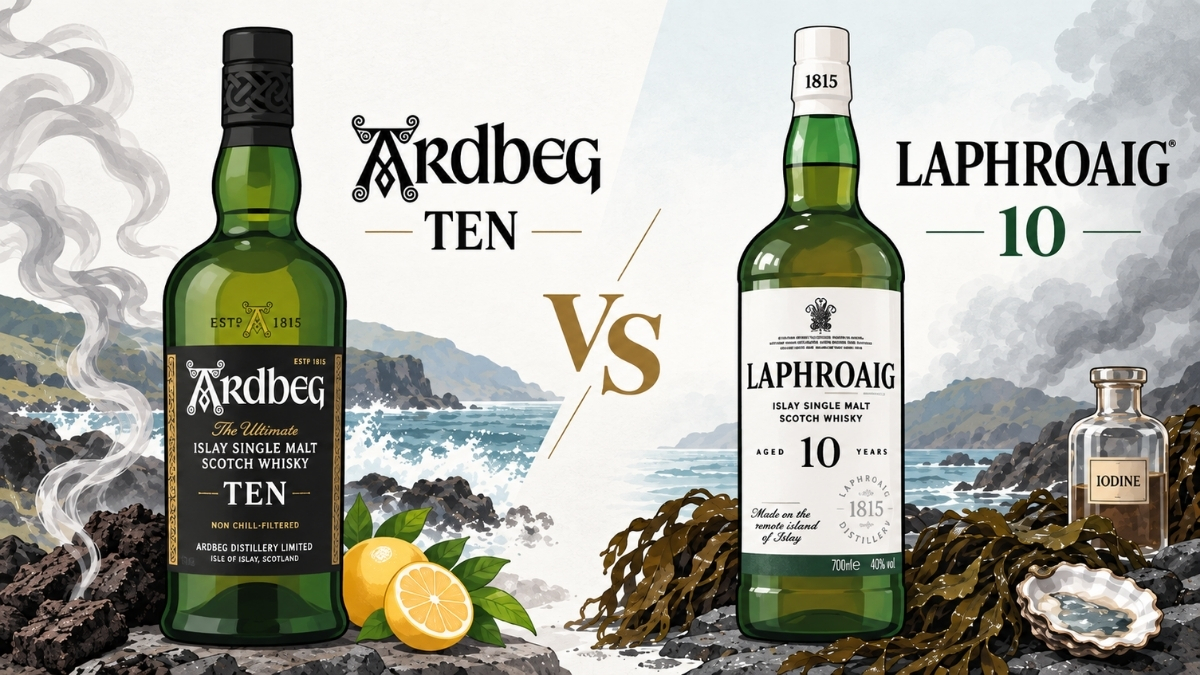
Ardbeg 10 and Laphroaig 10 are both 10-year-old, heavily peated Islay single malts that hit the top of Dram Verdict’s Smoke/Peat scale — but having tasted both in separate sessions, the short answer is that “which is smokier” is the wrong question. They’re equally intense; they’re just intense in almost opposite ways. Ardbeg 10 Year Old is direct, punchy and citrus-brightened, with a genuinely light body underneath the smoke. Laphroaig 10 Year Old is built around a distinctive medicinal, iodine-like character, carried by a heavier, oilier body.
Quick Verdict
If you want equally forceful peat without the medicinal edge, and you want a bottle that also makes a genuinely excellent highball, Ardbeg is the more complete package. If you specifically want — or are curious about — that iodine/antiseptic style of Islay whisky in a fuller-bodied glass, Laphroaig delivers it about as purely as any widely available bottle does. This comparison breaks down exactly where each one wins, using first-hand tasting and serve-by-serve evidence rather than specs or reputation.
Quick Comparison
| Ardbeg 10 Year Old | Laphroaig 10 Year Old | |
|---|---|---|
| Age | 10 years | 10 years |
| ABV | 46% | 43% (US) / 40% (UK-EU) |
| Character | Smoky, Citrusy, Punchy | Medicinal, Smoky, Maritime |
| Style | Direct, punchy, citrus-brightened | Medicinal, iodine-driven, oily |
| Sweetness | 2 / 5 | 3 / 5 |
| Fruit | 3 / 5 | 1 / 5 |
| Spice | 3 / 5 | 2 / 5 |
| Oak | 2 / 5 | 2 / 5 |
| Smoke / Peat | 5 / 5 | 5 / 5 |
| Body | 2 / 5 | 3 / 5 |
| Best neat | Tie | |
| Best with water | ✓ | |
| Best on the rocks | ✓ | |
| Best highball | ✓ | |
| More approachable | ✓ | |
| Typical US price (750ml) | ~$55–$75 | ~$43–$55 |
| Dram Verdict score | 4.5 | 4.3 |
| Value | Excellent | Excellent |
A few of those rows are genuinely close calls, explained in more detail below — this table is a starting point, not the whole argument.
The Biggest Difference: Smoke Style
Both bottles carry a Smoke/Peat rating of 5 on Dram Verdict’s Flavor Profile — the top of the scale, and a genuine tie. Neither one is smokier than the other in terms of how forcefully the peat shows up. What’s completely different is the character of that smoke. Ardbeg’s is direct and punchy, brightened by citrus and vanilla, with no medicinal quality anywhere in the first-hand tasting. Laphroaig’s is built around a powerful iodine-like, antiseptic edge that goes well beyond generic peat smoke — described independently as “medicinal” in both the first-hand tasting and Laphroaig’s own official tasting notes.
This is the single most important thing to understand before choosing between them: if you’re picturing a smokier-vs-less-smoky decision, you’re asking the wrong question. The real decision is whether you want that smoke to read as bright campfire-and-citrus intensity, or as a distinctly medicinal, iodine-driven character.
Nose
Ardbeg’s nose is extremely intense right from the first sniff, with vanilla and citrus alongside spice, smoke and sea air — the smoke announces itself immediately, but there’s no medicinal quality to it. Laphroaig’s nose leads with a powerful, iodine-like edge that’s genuinely medicinal rather than simply smoky, backed by sea air, leather and vanilla. Both are intense; only one reads as medicinal.
Palate
Ardbeg is very punchy on the palate, but the mouthfeel is surprisingly gentle — vanilla and malt meet lemon, smoke, a touch of seawater and white pepper, without ever feeling heavy. Laphroaig is oily with a substantial, heavy richness — malt, vanilla, licorice and citrus meet oak and smoke, plus a rocky-shoreline saltiness and that same distinctive medicinal note carried through from the nose. This is where the body difference is most obvious: Ardbeg stays light and direct, while Laphroaig carries real weight.
Finish
Both finish long. Ardbeg’s finish carries spice and smoky flavor together. Laphroaig’s finish carries smoke, bitterness and spice. Length is essentially a tie; the flavor makeup differs in the same way it does everywhere else — Ardbeg stays cleaner and more direct, Laphroaig stays heavier and more medicinal.
Which Is Smokier?
Neither, by Dram Verdict’s own first-hand evidence — both carry a Smoke/Peat rating of 5, the maximum on the scale. Raw phenol figures for the malted barley are sometimes cited as higher for Ardbeg than Laphroaig, but that number measures the malt before distillation, not what actually shows up in the glass — and in the tasting itself, both come through as maximally intense. What differs is style, not strength: see the smoke-style breakdown above.
Which Is More Medicinal?
Laphroaig, clearly and by a wide margin. Its iodine-like, antiseptic character is explicit, central and repeated throughout the first-hand tasting, and it’s corroborated by Laphroaig’s own official tasting notes, which also use the word “medicinal.” Ardbeg’s tasting evidence doesn’t include any medicinal, iodine or antiseptic language at all — its intensity comes from direct smoke, not a pharmaceutical-style edge.
Which Has More Body?
Laphroaig, and it isn’t close. Its Body rating of 3 reflects a genuinely oily, substantial mouthfeel, while Ardbeg’s Body of 2 reflects a lighter, leaner spirit — more of a lean, punchy style than a heavy one. Neither is a flaw: Ardbeg’s lighter body is a real style trait that keeps it from feeling heavy or fatiguing, not a weakness relative to Laphroaig’s fuller build.
Which Is Better Neat?
This is genuinely a tie. Both scored a perfect 5.0 out of 5 in Kaz’s own neat tasting, and both Reviews turned up no liquid-level weakness at all. Ardbeg’s slightly higher 4.5 overall Dram Verdict Score isn’t a neat-specific win — it reflects the whole package, including serve versatility — and shouldn’t be read as “better neat.” If you’re drinking exclusively neat, the honest answer is that both deliver at the same exceptionally high level, just in different flavor directions.
Which Is Better With Water?
Laphroaig, rated Good against Ardbeg’s Fair — both ratings come from directly comparable twice-up evidence, so this is a clean, apples-to-apples read. Ardbeg’s already-light body thins out further with a full twice-up pour, losing definition rather than opening up. Laphroaig’s fuller body holds up better with the same amount of water, and the flavor genuinely opens rather than washing out — though a light touch still works better than a heavy pour for either bottle.
Which Is Better On the Rocks?
Laphroaig again, rated Excellent against Ardbeg’s Good. Laphroaig’s oily body and medicinal smoke hold up particularly well over ice, with real sweetness coming through as the liquid warms. Ardbeg’s rocks serve is still clean and enjoyable, but its lighter profile loses balance sooner if the ice sits too long before you finish the glass.
Which Makes the Better Highball?
Ardbeg, and this is one of the clearest wins in either direction — rated Excellent against Laphroaig’s Very Good. Ardbeg’s citrus, lighter body and punchy structure translate exceptionally well to soda, staying easier to drink than any of its other serves. Laphroaig’s highball is still genuinely good, with its smoke and sea-air character holding their own against the fizz, but its denser, more medicinal profile doesn’t gain quite as much from the format as Ardbeg’s does.
Which Is More Approachable?
Neither is a gentle introduction to peated Scotch, but if you’re already curious about the style and choosing between these two specifically, Ardbeg is the more approachable of the pair. Its intensity is direct and citrus-brightened rather than medicinal, its body is lighter, and it’s more forgiving in a mixed drink. Laphroaig’s iodine-and-antiseptic signature is more polarizing and asks more of a first-time peated-whisky drinker — it’s a style you either respond to immediately or don’t.
Which Is Better for Peat Lovers?
This one genuinely depends on which kind of peat lover you are. If you want maximum smoke with citrus energy and serve versatility, Ardbeg delivers that. If you specifically chase the medicinal, iodine-driven style of Islay whisky, Laphroaig is arguably the purer example of it among widely available bottles. Neither wins outright here — it comes down to which sub-style of peat you’re actually after.
Both also sit within a much wider island style than just these two bottles — for how Ardbeg and Laphroaig fit alongside names like Lagavulin, Bowmore and Kilchoman, see Dram Verdict’s guide to Islay Scotch brands.
Value
Both bottles are rated “excellent value” on their individual Dram Verdict Reviews. Checking current US retail listings, Ardbeg 10 typically runs somewhere in the $55–$75 range for a 750ml bottle, while Laphroaig 10 typically runs closer to $43–$55 — so Laphroaig is, at most retailers, the less expensive bottle by a real but not dramatic margin. That gap doesn’t automatically make Laphroaig the better value, though: both Reviews independently rate their own liquid as “excellent value” for what it delivers, so the honest read is that each bottle justifies its own asking price on its own terms, and Laphroaig’s typically lower price is a genuine but secondary factor rather than a deciding one. Pricing varies by retailer, state and region, so treat these as a current snapshot rather than a fixed number for either bottle.
Ardbeg 10 vs Laphroaig 10: Which Should You Buy?
Buy Ardbeg 10 if you want equally intense peat without a medicinal edge; you like citrus and brightness in your smoke; you prefer a lighter-bodied whisky; you drink highballs regularly; or you want a punchier, more energetic style overall.
Buy Laphroaig 10 if you enjoy — or are curious about — iodine-driven, medicinal peat specifically; you want a fuller, oilier texture; you mostly drink on the rocks or with a splash of water; or you prefer a heavier, more maritime style overall.
Overall: Ardbeg 10 edges ahead as the slightly more complete package — its balance, clarity, and standout highball performance combine with a citrus-forward style that’s a genuine tie on smoke intensity and neat quality with Laphroaig, without asking as much of a first-time peated-whisky drinker. That said, this is a close call, not a rout: Laphroaig 10 is fully competitive, wins outright on water and rocks, and is arguably the better bottle outright for anyone who specifically wants that medicinal, iodine-driven style — which Ardbeg was never trying to be in the first place.
If you’re comparing further afield, Dram Verdict has also covered Ardbeg 10 vs Lagavulin 16 and Lagavulin 16 vs Laphroaig 10, which together with this comparison cover all three of Dram Verdict’s most-discussed Islay malts head-to-head.
- Is Ardbeg 10 smokier than Laphroaig 10?
-
No — both carry Dram Verdict’s maximum Smoke/Peat rating of 5. They’re equally intense but styled very differently: Ardbeg is direct and citrus-brightened, while Laphroaig is medicinal and iodine-driven.
- Which is better neat, Ardbeg 10 or Laphroaig 10?
-
It’s genuinely a tie. Both scored a perfect 5.0 out of 5 in Kaz’s own neat tasting, with no liquid-level weakness found in either bottle — the difference between them is style, not neat-drinking quality.
- Why does Laphroaig taste more medicinal than Ardbeg?
-
It’s a genuine difference in character, not intensity. Laphroaig’s iodine-like, antiseptic quality is explicit and central to its profile — and corroborated by its own official tasting notes — while Ardbeg’s tasting evidence contains no medicinal character at all.
- Which is more approachable, Ardbeg 10 or Laphroaig 10?
-
Ardbeg 10, generally, though neither is a gentle first peated Scotch. Its citrus-brightened, lighter-bodied style is more forgiving than Laphroaig’s polarizing medicinal signature.
- Which is better on the rocks, Ardbeg 10 or Laphroaig 10?
-
Laphroaig 10, rated Excellent against Ardbeg’s Good. Its oily body and medicinal smoke hold up especially well over ice.
- Which makes a better highball, Ardbeg 10 or Laphroaig 10?
-
Ardbeg 10, rated Excellent against Laphroaig’s Very Good. Its citrus and lighter body translate exceptionally well to soda.
Where to Buy
Ardbeg 10 Year Old
United Kingdom
Check Current Priceat The Whisky ExchangeLaphroaig 10 Year Old
United Kingdom
Check Current Priceat The Whisky Exchange
We may earn a commission if you buy through our links. This never affects our scores.





Comments