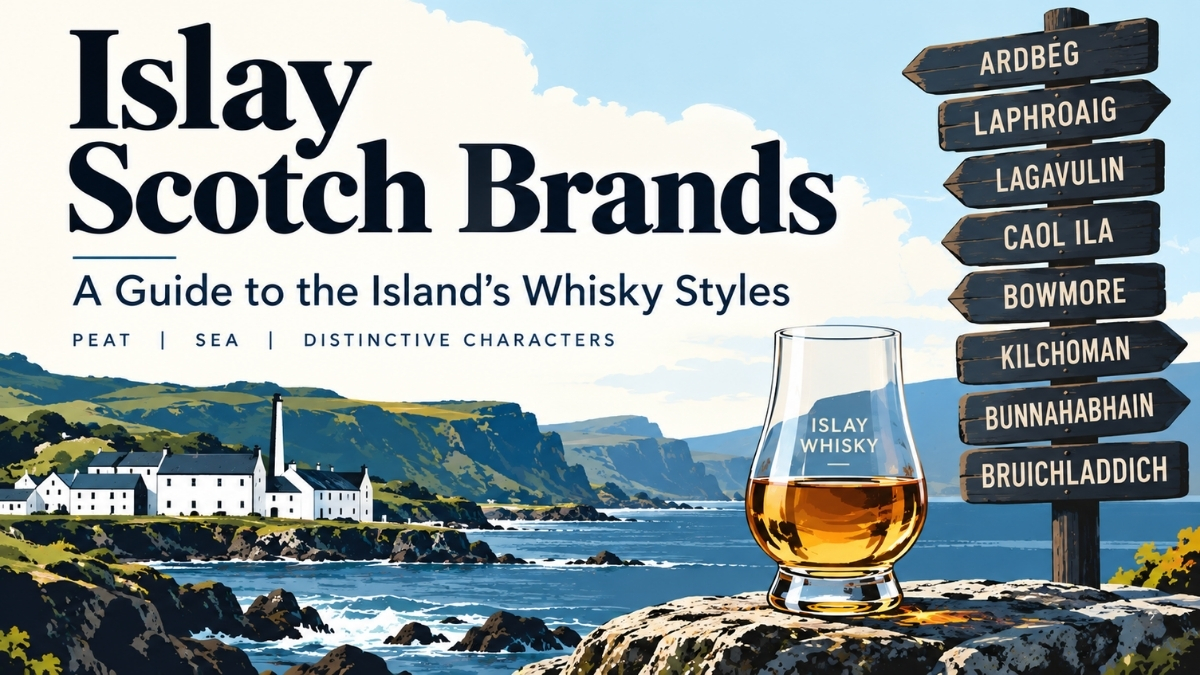
Islay is Scotland’s most famous whisky island, and its reputation is built almost entirely on peat smoke. That reputation is earned, but it’s incomplete: the island’s brands differ enormously in how much smoke they use, what kind of smoke it is, and how that smoke sits alongside sweetness, fruit and body. Some Islay whisky is intensely medicinal. Some is bright and citrusy. Some has almost no smoke at all. Dram Verdict has tasted and reviewed first-hand expressions from most of the island’s core distilleries, so this guide maps out how the major Islay Scotch brands actually differ — not just that they’re all “smoky.”
What Makes Islay Whisky Different?
Islay’s whisky is shaped by peat, but “peated” isn’t one flavor. Peat is burned to dry malted barley during production, and the smoke it produces can read as anything from a clean bonfire to hospital-grade iodine to sweet, ashy woodsmoke, depending on the distillery, the water source, the stills and the cask.
You’ll often see peat levels described in PPM (parts per million) — a measurement of phenol content in the malted barley before distillation, not a direct score of how smoky the finished whisky will taste. Two whiskies with similar PPM can taste very different once you account for still shape, cask maturation and ABV, and PPM figures aren’t something Dram Verdict treats as a substitute for actually tasting the whisky.
Islay also isn’t uniformly peated at all. A few of the island’s most respected whiskies use little or no peat, and the “Islay equals smoke” shorthand undersells them.
Islay Scotch Brands at a Glance
| Brand / Distillery | Typical Style | Peat Level | Representative Bottle | DV Score | Review |
|---|---|---|---|---|---|
| Ardbeg | Intense, citrus-driven peat | Heavily peated | Ardbeg 10 | 4.5 | Reviewed |
| Laphroaig | Medicinal, iodine-forward peat | Heavily peated | Laphroaig 10 | 4.3 | Reviewed |
| Lagavulin | Rich, mature smoke (16) or fresh, forceful smoke (8) | Heavily peated | Lagavulin 16 | 4.9 | Reviewed |
| Caol Ila | Balanced, bright smoke with real complexity | Heavily peated | Caol Ila 12 | 4.7 | Reviewed |
| Bowmore | Composed smoke with sherry-driven sweetness | Moderate-to-heavily peated | Bowmore 12 | 3.9 | Reviewed |
| Kilchoman | Young, fresh, citrus-and-grass peat | Heavily peated | Machir Bay | 4.0 | Reviewed |
| Ardnahoe | Dry, smokehouse-style peat | Heavily peated | Infinite Loch | 4.4 | Reviewed |
| Bunnahabhain | Fruity, nutty, unpeated coastal character | Unpeated (core range) | Bunnahabhain 12 | 4.4 | Reviewed |
| Bruichladdich / Port Charlotte / Octomore | Unpeated → heavily peated → extreme peat, from one distillery | Varies by range | Classic Laddie / Port Charlotte 10 / Octomore | — | Not yet reviewed |
Ardbeg
Score: 4.5 · Character: Smoky, Citrusy, Punchy
Ardbeg’s flagship, Ardbeg 10, is peat-forward from the first sniff to the last drop of the finish — Kaz’s own tasting describes smoke announcing itself immediately, backed by vanilla and citrus rather than easing in gradually. What keeps it from being one-note is a genuinely light, punchy body: the mouthfeel is gentler than the aroma promises, so the whisky reads as energetic rather than heavy.
That combination — big smoke, citrus brightness, a lean rather than oily body — is the clearest one-line summary of the Ardbeg house style available from Dram Verdict’s own tasting. It’s punchier and lighter-bodied than Lagavulin 16, and closer in overall force to Lagavulin 8, but with a distinct citrus lift that neither of those shares.
There’s no meaningful liquid weakness in the neat pour; the real caveat is that this style of whisky isn’t for everyone, and no amount of vanilla underneath will convert someone who doesn’t like smoke in the first place.
Laphroaig
Score: 4.3 (Laphroaig 10) · Character: Medicinal, Smoky, Maritime
Laphroaig’s reputation for a genuinely medicinal, iodine-like character isn’t exaggerated — it’s the first thing Kaz’s own nose picked up on Laphroaig 10, ahead of the more familiar smoke, sea air and vanilla underneath. It’s also heavier and oilier than several of its Islay peers, giving the whisky real substance rather than just intensity.
Laphroaig Four Oak shows how much that house style can flex: matured across four different cask types, it keeps Laphroaig’s smoke and medicinal edge but rounds both off into something noticeably lighter and more approachable — genuinely excellent as a highball, though it does trade away some of the complexity and body of the fuller-strength core range to get there. Four Oak is also a Global Travel Retail exclusive, so it’s not something you’ll typically find at a standard US retailer.
Laphroaig isn’t a one-note “medicine” whisky — it’s a specific, polarizing style built on real richness, and Four Oak proves the distillery can dial that intensity up or down without losing its identity.
Lagavulin
Scores: Lagavulin 16 — 4.9 · Lagavulin 8 — 4.3
Characters: 16 — Peaty, Rich, Complex · 8 — Smoky, Fresh, Powerful
Dram Verdict has reviewed two genuinely different sides of Lagavulin, and the gap between them is instructive. Lagavulin 16 is the distillery’s benchmark: 16 years in cask have rounded aggressive peat into something layered rather than just forceful, with honey and dark chocolate sweetness carried by a full, oily body — the maturation has smoothed out the rough edges without dulling the character, and the peat stays fully integrated rather than reading as one-dimensional smoke.
Lagavulin 8 is a different animal: younger, punchier and more forceful, closer in raw intensity to Laphroaig 10 or Ardbeg 10 than to its own older sibling. Kaz’s own tasting found one genuine limitation here — at 48% ABV, the body doesn’t quite match the intensity of the smoke, so it reads as satisfying rather than truly substantial.
The lesson for a newcomer: “Lagavulin” doesn’t mean one flavor. The 16 is composed and mature; the 8 is fresh and forceful. Neither is a beginner’s whisky, but they represent genuinely different points on the same distillery’s range.
Caol Ila
Score: 4.7 · Character: Smoky, Citrusy, Oily
Caol Ila 12 is real, substantial peat smoke that shares space with lemon, malt sweetness and floral notes rather than dominating the glass — Kaz’s own tasting found no meaningful weakness in the neat pour, only the honest caveat that drinkers chasing the most aggressive possible peat may find it too composed.
Compared with more forceful Islay malts like Ardbeg 10 or Laphroaig 10, Caol Ila sits at a genuinely different point on the intensity spectrum: real smoke, built around balance and complexity rather than overt punch or a medicinal edge. It’s one of the highest-scoring bottles in Dram Verdict’s current Islay lineup, and balance rather than raw force is the reason why.
Bowmore
Score: 3.9 · Character: Smoky, Chocolatey, Maritime
Bowmore 12 does exactly what it sets out to do: real Islay smoke held in genuine balance with sherry-cask sweetness, dark chocolate and honey, calmer than Ardbeg 10 or Laphroaig 10 without ever feeling weak. Dram Verdict’s own honest reservation is one of identity rather than quality — sweetness, fruit and smoke all sit at a comfortable middle, and the result, while genuinely pleasant, doesn’t leave as sharp a signature as some of its more extreme neighbors.
That makes Bowmore 12 a sensible next step for someone exploring Islay who wants smoke balanced by real sweetness rather than intensity for its own sake, even if it’s less memorable than a bottle built around one unmistakable trait.
Kilchoman
Score: 4.0 · Character: Smoky, Citrusy, Maritime
Kilchoman is Islay’s first new distillery in over a century, and it’s a genuine working farm distillery — it grows and malts its own barley on-site for its most limited releases. Machir Bay, the distillery’s flagship and the bottle Dram Verdict has actually reviewed, is the more widely available core expression rather than the ultra-limited 100%-estate bottling.
Kaz’s own tasting found real, unmistakable peat smoke carried by a young, vibrant freshness — citrus, brine, fresh-cut grass — rather than the heavier, more medicinal weight some other Islay malts lean into. In Dram Verdict’s own comparative terms, it sits closer to Ardbeg 10 and Laphroaig 10 in raw smoke intensity than to the calmer Caol Ila 12 or sherry-leaning Bowmore 12, but its youth and citrus-and-grass character give it a genuinely different personality from either.
One practical note: US pricing for Machir Bay varies unusually widely by retailer, so whether it’s a good buy depends more on where you find it than on the liquid itself.
Ardnahoe
Score: 4.4 · Character: Smoky, Herbal, Maritime
Ardnahoe is one of Islay’s newest distilleries, opened in 2018 and owned by the independent bottler Hunter Laing; its first official release only arrived in 2024. Infinite Loch is an impressively composed whisky for something this young — real, intense peat smoke in a drier, smokehouse-style register, with a subtle sherry-cask influence rather than a heavy, oily peat-bomb character.
Kaz, a self-described fan of Caol Ila, found the experience “not too far off” from Caol Ila 12 — closer to that composed, drier style than to the heavier intensity of Ardbeg 10 or Laphroaig 10. It performs best neat and on the rocks, where its 50% ABV and oily texture hold up well, but loses richness once diluted with water.
As one of the island’s newest entrants, Ardnahoe is worth watching — it’s already showing a distinct house style rather than just imitating its older neighbors.
Bunnahabhain
Score: 4.4 · Character: Nutty, Fruity, Maritime
Bunnahabhain is the clearest evidence that “Islay” doesn’t automatically mean heavily peated. Bunnahabhain 12, the distillery’s core expression, has no peat smoke at all — instead, Kaz’s own tasting found dried fruit, dark chocolate, nuts and a hint of oak sitting over real brine and coastal character, rich and complex without ever feeling heavy.
That doesn’t mean the whole distillery is smoke-free — Bunnahabhain does produce peated expressions in its wider range — but the widely available 12 Year Old, the bottle Dram Verdict has actually tasted, is built around sherry-driven sweetness and maritime character rather than peat. If you’re specifically chasing smoke, this isn’t the bottle; if you want genuine Islay coastal character without it, this is one of the clearest examples on the island.
Bruichladdich
Bruichladdich Distillery is a useful reminder that a single Islay producer doesn’t have to mean a single style. One distillery, working from the same stills and the same water source, releases whisky under three genuinely different identities: Bruichladdich itself, Port Charlotte and Octomore — all conceived, distilled, matured and bottled at the one site. Dram Verdict has not yet reviewed a bottle from any of the three ranges, so everything below reflects official brand information rather than Kaz’s own tasting.
Bruichladdich
The Bruichladdich-branded range is the distillery’s unpeated side, built around Islay’s terroir and barley sourcing rather than smoke — the Classic Laddie is the standard expression. Not yet reviewed by Dram Verdict.
Port Charlotte
Port Charlotte, named after the Islay village, is Bruichladdich Distillery’s heavily peated range. The producer positions it as the counterpoint to the unpeated Bruichladdich-branded whisky, made at the same distillery from the same stills — not a separate, standalone distillery. Not yet reviewed by Dram Verdict.
Octomore
Octomore is Bruichladdich Distillery’s most extreme range, and the producer itself markets it as the world’s most heavily peated single malt whisky. Its releases use very high phenol (peat) specifications — well above typical Islay levels — though the exact figure varies release to release, and Bruichladdich’s own maturation and cask choices mean the finished whisky doesn’t taste simply “more smoky” in direct proportion to that number. Octomore has been produced since 2008 and is generally matured for around five years before release. Not yet reviewed by Dram Verdict.
Other Islay Distilleries to Know
Islay’s distillery count isn’t fixed — the island is home to several active producers, and more have been opening or reopening in recent years. Diageo reopened the historic Port Ellen distillery in March 2024 after a 40-year closure, and newer producers such as Laggan Bay began production in 2026. Dram Verdict hasn’t reviewed bottles from these yet, so they’re worth knowing about rather than fully covered here.
Which Islay Style Should You Try First?
There’s no single starting point that’s right for everyone — it depends on what kind of smoke, or lack of it, you’re actually looking for.
- Punchy, citrus-driven peat: try Ardbeg 10
- Genuinely medicinal, iodine-forward peat: try Laphroaig 10
- Rich, mature, well-integrated smoke: try Lagavulin 16
- Smoke balanced by real complexity rather than raw force: try Caol Ila 12
- Smoke balanced by sherry sweetness: try Bowmore 12
- A young, fresh, citrus-and-grass take on peat: try Kilchoman Machir Bay
- A newer distillery’s dry, smokehouse-style peat: try Ardnahoe Infinite Loch
- Genuine Islay character with no peat at all: try Bunnahabhain 12
- Exploring peat intensity systematically from one distillery: try Bruichladdich’s unpeated core range, then Port Charlotte, then Octomore
None of these is objectively better than the others — they’re different answers to different questions about what you actually want in the glass.
Smoky vs Unpeated Islay Whisky
It’s worth saying plainly: Islay does not equal “always heavily peated.” Bunnahabhain’s core 12 Year Old carries no peat smoke at all, and Bruichladdich’s own unpeated range makes the same point from a different distillery. At the other extreme, Port Charlotte and Octomore — both made at Bruichladdich Distillery — show how far in the opposite direction a single Islay producer can go.
If you’re building a picture of the island, it’s more accurate to think of Islay whisky as sitting on a spectrum — from Bunnahabhain and Bruichladdich’s unpeated whiskies, through the moderate-to-heavy smoke of Bowmore, Kilchoman and Ardnahoe, up to the intense peat of Ardbeg, Laphroaig, Lagavulin and Caol Ila, and finally to Port Charlotte and Octomore’s deliberately extreme end — than as one uniform “smoky whisky” region.
Compare the Classic Islay Bottles Head to Head
If you’re choosing between Ardbeg 10, Laphroaig 10 and Lagavulin 16 specifically, Dram Verdict has compared each pairing head to head, using the same first-hand tasting and serve-by-serve evidence as the individual Reviews above:
Islay Scotch Brands FAQ
- What are the main Islay Scotch brands?
-
Islay’s major current whisky brands include Ardbeg, Laphroaig, Lagavulin, Caol Ila, Bowmore, Kilchoman, Ardnahoe, Bunnahabhain and Bruichladdich (which also produces the Port Charlotte and Octomore ranges). The island has several other active and newly reopened distilleries as well.
- Which Islay whisky is the smokiest?
-
There’s no single, universally agreed answer, because “smokiest” depends on what you’re measuring. By phenol specification, Bruichladdich’s Octomore range is marketed by its own producer as the world’s most heavily peated single malt whisky. But phenol levels in the malted barley don’t translate directly into perceived smoke intensity in the finished whisky — production, cask maturation and ABV all shape how that smoke actually tastes.
- Are all Islay whiskies peated?
-
No. Bunnahabhain’s core 12 Year Old has no peat smoke at all, and Bruichladdich’s own unpeated range makes the same point. Peat intensity varies enormously across the island’s brands, from none to extreme.
- Is Bruichladdich peated?
-
The Bruichladdich-branded range itself is unpeated. The same distillery also produces the heavily peated Port Charlotte range and the extremely heavily peated Octomore range — three different identities from one site.
- Are Port Charlotte and Octomore Bruichladdich whiskies?
-
Yes. Port Charlotte and Octomore are both produced at Bruichladdich Distillery, not at separate distilleries. They represent the peated and extremely peated sides of the same producer’s range.
- Is Bunnahabhain smoky?
-
Bunnahabhain’s widely available 12 Year Old is not smoky — it’s built around dried fruit, nuts and maritime character instead. The distillery does produce some peated expressions, but its core range is defined by the absence of smoke rather than its presence.
- Which Islay whisky is best for beginners?
-
It depends on what you’re curious about rather than one universal answer. Readers who want to know if they like peat at all might start with a more composed style like Caol Ila 12 or Bowmore 12; readers who want genuine Islay character without any smoke could start with Bunnahabhain 12 instead.
Final Thoughts
Islay earned its reputation on peat smoke, but treating every Islay bottle as interchangeably “smoky” misses most of what makes the island interesting. Ardbeg, Laphroaig, Lagavulin and Caol Ila all deliver real peat, but in genuinely different registers — citrusy and punchy, medicinally intense, richly mature and cleanly balanced, respectively. Bowmore, Kilchoman and Ardnahoe each bring their own angle on smoke. Bunnahabhain and Bruichladdich’s own unpeated range prove smoke was never a requirement in the first place — and Port Charlotte and Octomore, from that same Bruichladdich distillery, show just how far in the opposite direction a single Islay producer can push it.
Dram Verdict has tasted and reviewed first-hand expressions from most of these distilleries, and the differences described here come from that tasting — not from repeating the same “smoky Islay whisky” description nine times over.







Comments