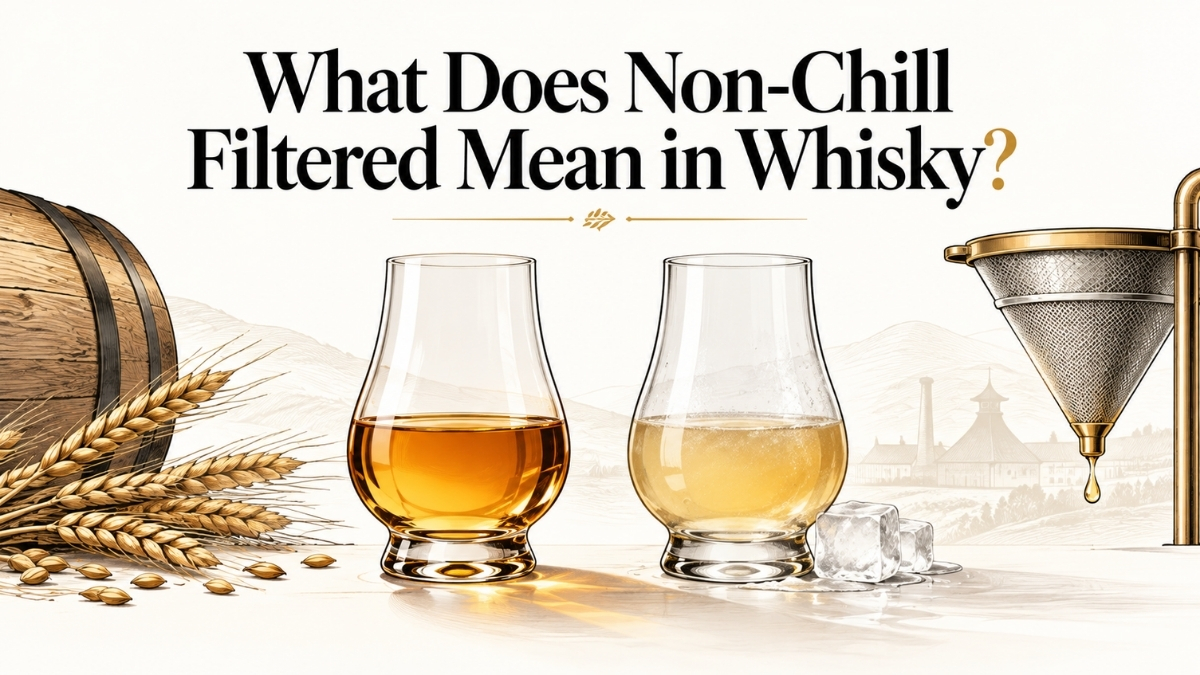
“Non-chill filtered” means the whisky was bottled without chill filtration — a step in which whisky is cooled and passed through a fine filter to remove compounds that can make it look cloudy when it gets cold or when water or ice is added. That haze is essentially cosmetic: it’s reversible, and it isn’t a sign that anything is wrong with the whisky.
Two things are worth knowing before going further. First, non-chill filtered doesn’t automatically mean better — it tells you how a whisky was processed, not how good it is. Second, it isn’t the same as “natural colour.” Filtration and colouring are separate decisions, and a label can state one without the other.
What Is Chill Filtration?
Chill filtration is a finishing step carried out before bottling. The whisky is cooled so that certain compounds come out of solution, then run through a fine filter that catches them. The goal is visual: a whisky that stays bright and clear on the shelf, in a cold warehouse, or in a glass with ice.
Producers don’t all describe the process in the same way, and there’s no single industry-wide temperature. As one concrete example, Arran describes chill filtration as cooling the whisky to between -10°C and +4°C before passing it through a fine filter to remove elements such as proteins and esters, in order to keep it clear when served with ice or in cooler conditions. That’s one distillery’s description of the technique rather than a universal specification.
What Does Non-Chill Filtered Mean?
It means that chill-filtration step was skipped. The compounds that would have been removed stay in the bottle, which is why a non-chill filtered whisky can turn hazy when chilled or diluted.
It’s easy to read more into the phrase than it actually says. Non-chill filtered does not mean:
- Unfiltered. The term refers specifically to chill filtration. “Unfiltered” isn’t a standardised label term, so if a producer uses it, it means whatever that producer says it means.
- Cask strength. Bottling strength and filtration are separate choices. A cask-strength whisky may well be non-chill filtered, but one doesn’t prove the other — see our guide to barrel proof vs cask strength for what the strength terms mean.
- Natural colour. Covered in its own section below.
It’s also primarily a producer’s description rather than a regulated category. The UK’s Scotch Whisky Regulations 2009, for example, contain no provision on chill filtration at all. In practice, a whisky is non-chill filtered when the producer says it is — usually on the label or the official product page.
Why Does Whisky Turn Cloudy?
The short answer: some naturally occurring compounds in whisky dissolve comfortably in alcohol but much less well in water or at low temperatures. When the whisky gets colder or its alcohol content drops, those compounds start to clump together, and the liquid scatters light instead of looking clear.
The compounds most often named are esters formed from long-chain fatty acids — ethyl laurate and ethyl palmitate are the usual examples — along with other fatty-acid-derived compounds. That’s the explanation given in a guest article on chill filtration published by The GlenAllachie and in Annandale Distillery’s technical notes. Arran’s own description refers more broadly to proteins and esters.
Two conditions make haze more likely:
- Lower temperature — ice, a cold room, or a bottle stored somewhere cold.
- Lower alcohol — adding water, or ice melting into the glass, dilutes the whisky and makes those compounds less soluble.
The haze is reversible. As The GlenAllachie’s guest article puts it, the cloudiness is only a visual issue and disappears again once the whisky returns to room temperature.
Why Do Distilleries Chill Filter Whisky?
Mainly for appearance and consistency. A clear, bright whisky is what many drinkers expect to see, and haze — in the bottle, on a cold shelf, or in a glass with ice — can easily be mistaken for a fault. The GlenAllachie’s guest article notes that consumers whose whisky turned cloudy often didn’t find it attractive, and some assumed it was a quality problem. Chill filtration keeps the whisky looking the same from bottle to bottle, whatever the storage and serving conditions.
It’s also a reasonable technical choice at lower bottling strengths. Arran — which avoids chill filtration for most of its range — acknowledges that the process has its merits for lower-ABV expressions, precisely because they’re more prone to haze.
Does Chill Filtration Affect Taste or Texture?
Possibly a little — but the effect is debated, and it’s smaller than the passion around the topic might suggest.
What’s reasonably clear is that chill filtration removes the compounds responsible for haze, and some of those compounds may contribute to a whisky’s character. Beyond that, the views differ:
- Producers who avoid it argue that something is lost. Arran, for example, says subtle flavour compounds and aromatic nuances can be lost in filtration.
- Some technical explanations point to texture more than flavour. The GlenAllachie’s guest article describes the haze-forming esters as contributing mainly to mouthfeel rather than aroma, noting that a loss of mouthfeel is usually what gets reported — while acknowledging that scientific evidence is limited.
- Other sources describe the effect as modest. Annandale suggests chill filtering could remove some fruity esters, but probably only to a very modest extent. Scotch Whisky magazine notes that some blind tasting studies suggest little impact on flavour, even for expert tasters.
A fair summary: non-chill filtered whisky may retain a little more of its original texture and character, but the difference is likely to be subtle, and it isn’t something you can assume from the label alone. The spirit, the casks, the length of maturation, the blending and the bottling strength have a far bigger influence on how a whisky tastes.
Why Is 46% ABV Common in Non-Chill Filtered Whisky?
Because higher alcohol keeps those haze-forming compounds in solution. At a high enough strength, a non-chill filtered whisky is much less likely to go cloudy in the bottle, so many producers who skip chill filtration bottle at around 46% ABV or above.
But 46% is a common practical benchmark, not an industry-wide rule. Sources don’t even agree on a single number: Annandale treats roughly 46% as the critical point, The GlenAllachie’s guest article cites 45%, and Arran draws its own line at 43%. None of these is a legal threshold.
Arran is a useful real-world example of how one producer handles it. Its stated policy is to avoid chill filtration when a whisky is bottled above 43% ABV or at cask strength, and it usually bottles at 46%. So the Arran 10 Year Old, at 46%, is non-chill filtered — the official product page says so — while Arran’s Barrel Reserve, a lighter 43% single malt, is chill filtered by choice. That’s Arran’s own policy, not a rule the rest of the industry follows.
Keep two cautions in mind:
- ABV alone doesn’t tell you. A strength of 46% or more doesn’t prove a whisky is non-chill filtered, and a lower strength doesn’t prove it has been chill filtered. The producer’s own statement is the reliable signal.
- High strength only prevents haze at full strength. As Scotch Whisky magazine points out, adding water or ice lowers the strength in the glass — so even a 46% non-chill filtered whisky can turn hazy once it’s diluted.
Non-Chill Filtered vs Natural Colour
These are two independent statements:
- Non-chill filtered is about a filtration step.
- Natural colour / no added colour is about whether colouring was added.
Colouring is permitted in Scotch: the Scotch Whisky Regulations 2009 allow plain caramel colouring to be added. So a whisky can be non-chill filtered with colour added, chill filtered at natural colour, both, or neither. One claim never guarantees the other.
Some bottles state both. The GlenAllachie 12 Year Old is described on its official page as non-chill filtered with no colour added, and Bunnahabhain 12 as non-chill filtered and natural colour. Others state only one. Aultmore 12 is officially described as non-chill filtered and presented “at its natural, light colour” — wording that describes its appearance but isn’t an explicit no-added-colour statement, so we don’t treat it as one. When a producer doesn’t make a colour statement, the honest answer is simply that it isn’t stated.
Examples of Non-Chill Filtered Whiskies We’ve Reviewed
These are whiskies we’ve reviewed whose producers state, on the official product page, that they’re non-chill filtered. The list isn’t a ranking — it’s here to show how the statements look in practice, and how the colour statement varies.
| Whisky | ABV | Filtration (official wording) | Colour |
|---|---|---|---|
| Arran 10 Year Old | 46% | “non-chill filtered” | Natural colour (stated) |
| The GlenAllachie 12 Year Old | 46% | “NON-CHILL FILTERED” | No colour added (stated) |
| Bunnahabhain 12 | 46.3% | “Non-chill filtered” | Natural colour (stated) |
| Ardnahoe Infinite Loch | 50% | “no chill-filtration” | No artificial colouring (stated) |
| Ardbeg 10 | 46% | “Non Chill-filtered” | Not stated |
| Aultmore 12 | 46% | “non-chill filtered” | Not confirmed (“natural, light colour” describes appearance only) |
| Teeling Single Malt (Irish) | 46% | “non-chill filtered” | Not stated |
Note how many of them sit at 46% — and how Ardnahoe’s Infinite Loch, at 50%, is a reminder that 46% is a common landing point rather than a requirement.
Is Non-Chill Filtered Whisky Better?
Not automatically. “Non-chill filtered” tells you something real about how a whisky was finished, and many enthusiasts like knowing that nothing was removed for cosmetic reasons. It can also be a useful sign of a producer’s general approach.
What it can’t tell you is whether a whisky is balanced, complex or enjoyable. The whiskies in the table above vary widely in style and in how much we liked them — the filtration statement is the one thing they share. That’s why our reviews judge the whisky in the glass and treat details like filtration and colour as useful context, not as reasons to score a bottle higher.
FAQ
- Is non-chill filtered whisky better?
-
Not automatically. It tells you a filtration step was skipped, which may help preserve a little more of the whisky’s original texture, but it doesn’t guarantee quality. The spirit, casks and maturation matter far more.
- Why does non-chill filtered whisky go cloudy?
-
It still contains compounds — mainly esters of long-chain fatty acids — that become less soluble when the whisky is cold or diluted. They cluster together and scatter light. The haze is harmless and clears again as the whisky warms back up.
- Does adding water or ice make whisky cloudy?
-
It can, especially with non-chill filtered whisky. Water lowers the alcohol content and ice lowers the temperature, and both make haze-forming compounds come out of solution. Chill-filtered whisky is much less likely to cloud because most of those compounds have been removed.
- Is 46% whisky always non-chill filtered?
-
No. 46% is a common strength for non-chill filtered whisky because higher alcohol helps prevent haze, but it isn’t a legal or universal threshold, and producers set their own policies. Check the label or the official product page.
- Is non-chill filtered the same as natural colour?
-
No. Non-chill filtered is about filtration; natural colour (or “no colour added”) is about whether colouring was added. A whisky can be one without the other, so look for both statements separately.
- Is non-chill filtered the same as unfiltered?
-
Not necessarily. Non-chill filtered refers specifically to skipping chill filtration. “Unfiltered” isn’t a standardised label term, so how much it covers depends on the producer using it.
- Can non-chill filtered whisky have bits floating in it?
-
Occasionally, haze-forming compounds can clump into faint wisps or flakes, sometimes called “floc,” particularly after cold storage. That’s different from cork fragments or anything that looks like contamination. If you’re unsure what you’re seeing, contact the retailer or producer rather than assuming it’s normal.
Final Thoughts
“Non-chill filtered” is one of the more useful phrases on a whisky label, as long as it’s read for what it is: a statement that the whisky skipped a mostly cosmetic filtration step, so it may turn hazy with ice, water or cold. It isn’t a legal category in the Scotch rules, it isn’t the same as natural colour, and 46% ABV isn’t a guarantee of it. Whether it makes a noticeable difference in the glass is genuinely debated — and in the end, the whisky itself matters far more than any single line on the label.





Comments