
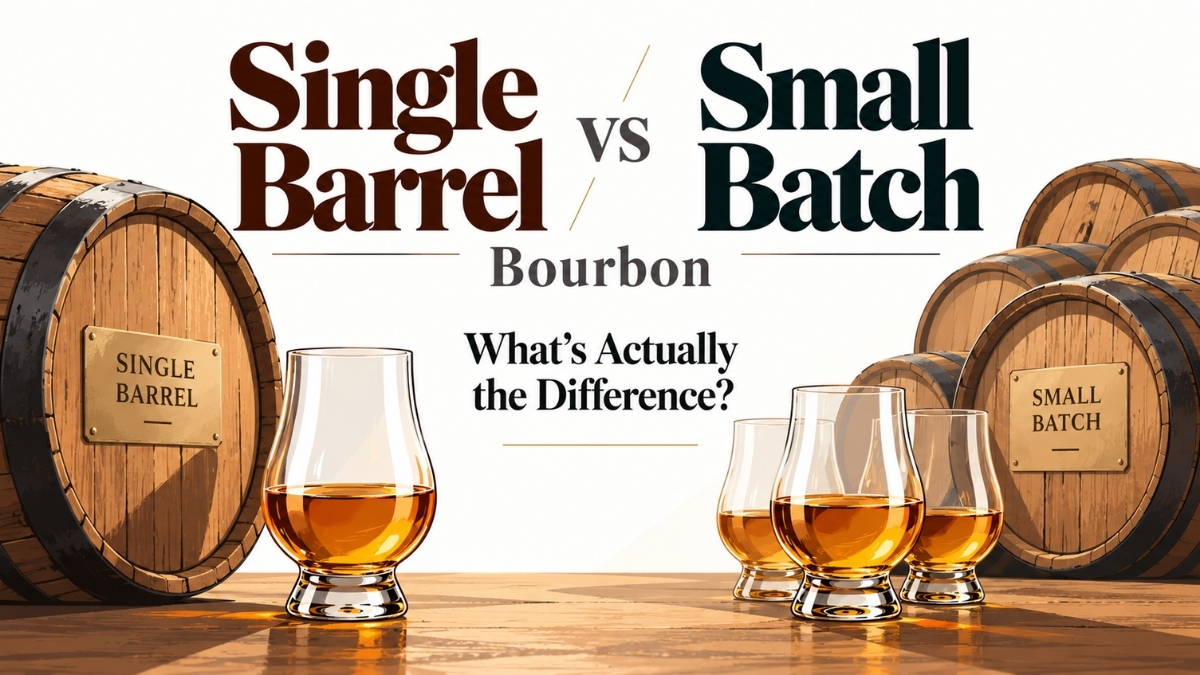
Single-barrel bourbon conventionally comes from one individual barrel rather than a blend of many. Small batch generally refers to a producer-selected batch of barrels blended together — but there’s no federal standard defining how many barrels make a batch “small,” so the term can mean very different things from one producer to the next.
What “Single Barrel” Actually Means
In common bourbon usage, a single-barrel bottling comes from one individual barrel rather than a blend of multiple barrels. Because every barrel ages a little differently depending on where it sat in the rickhouse, a single-barrel release captures one specific barrel’s character rather than an averaged-out house style. That’s the appeal — and it’s also why two bottles drawn from different barrels of the same single-barrel label can taste noticeably different from each other. That’s not inconsistency; it’s simply how the format works.
What “Small Batch” Actually Means (and Why There’s No Federal Standard)
Small batch generally refers to whiskey blended from a selected batch of barrels, but there is no federal standard defining how many barrels qualify as “small,” or prescribing one particular production method. Each producer sets its own scale and process — blending can be used to shape a consistent house or batch profile, though not every small-batch release is designed to match the previous one exactly.
The federal whisky standards of identity in 27 CFR 5.143 do not define either “single barrel” or “small batch.” There is no federal barrel-count threshold for the term — in practice, one producer’s “small batch” might mean a dozen barrels, another’s several hundred. That doesn’t mean labeling is a free-for-all; bourbon labels are still subject to other federal requirements. It just means these two specific terms aren’t defined as standards of identity, so the label alone won’t tell you which barrel count applies to what’s in your glass.
Does One Actually Taste Better?
Neither format is inherently better — they’re solving different problems. Single barrel is about individuality: you’re tasting exactly what that one barrel became. Small batch is about selection and blending: the producer can combine multiple barrels to shape a desired profile and reduce the influence of any one barrel. That can create more consistency from batch to batch, but the term itself doesn’t guarantee that every release will taste exactly the same. Which you prefer comes down to whether you’re drawn to the individuality of a single barrel or to the more blended, producer-shaped profile of a small batch.
What This Looks Like in the Glass: Baker’s 7 Year Single Barrel
Baker’s 7 Year Single Barrel, which I’ve tasted and reviewed, is a real example of the format: every bottle comes from one individual barrel and is bottled at 107 proof. That means the exact bottle you buy is a specific barrel’s expression of Jim Beam’s house style — oak-forward, spice-forward, and built to handle that proof without feeling hot. With Baker’s, you’re getting one barrel’s particular version of the house style rather than a whiskey assembled from multiple barrels.
What This Looks Like in the Glass: Four Roses Single Barrel
Four Roses Single Barrel, which I’ve tasted and reviewed, is a second real example of the same format from a completely different recipe system: Four Roses combines two mashbills with five proprietary yeast strains to produce ten distinct bourbon recipes, and its standard Single Barrel release is always bottled from the OBSV recipe — a higher-rye mashbill paired with the brand’s “V” yeast. Because it’s still a genuine single-barrel release, tasting a few different bottles turned up real bottle-to-bottle variation even with the recipe held constant — a good illustration of the point above: the format itself doesn’t guarantee identical bottles, just one un-blended barrel’s specific expression of that recipe.
What This Looks Like in the Glass: Elijah Craig Small Batch
Elijah Craig Small Batch, which I’ve tasted and reviewed, sits on the other side of that split: it’s assembled from a limited, hand-selected batch of barrels rather than one, and Heaven Hill doesn’t publish an exact barrel count for it. That blending approach is part of why it comes across as more straightforward and consistent than an individual-barrel bottling — you’re getting Heaven Hill’s house style smoothed across multiple barrels rather than one barrel’s specific quirks.
How to Tell Which One You’re Buying
You’ll generally see “Single Barrel” prominently on the label, because it’s a specific, meaningful claim about how the bourbon was bottled. “Small Batch” is more of a producer-defined designation than a standardized specification — the label often won’t tell you the barrel count, so if that detail actually matters to you, your best bet is checking the distillery’s own materials rather than assuming from the label alone. Either way, neither term tells you anything about proof, age, or price on its own — those are separate things worth checking regardless of which format you’re buying.



Comments