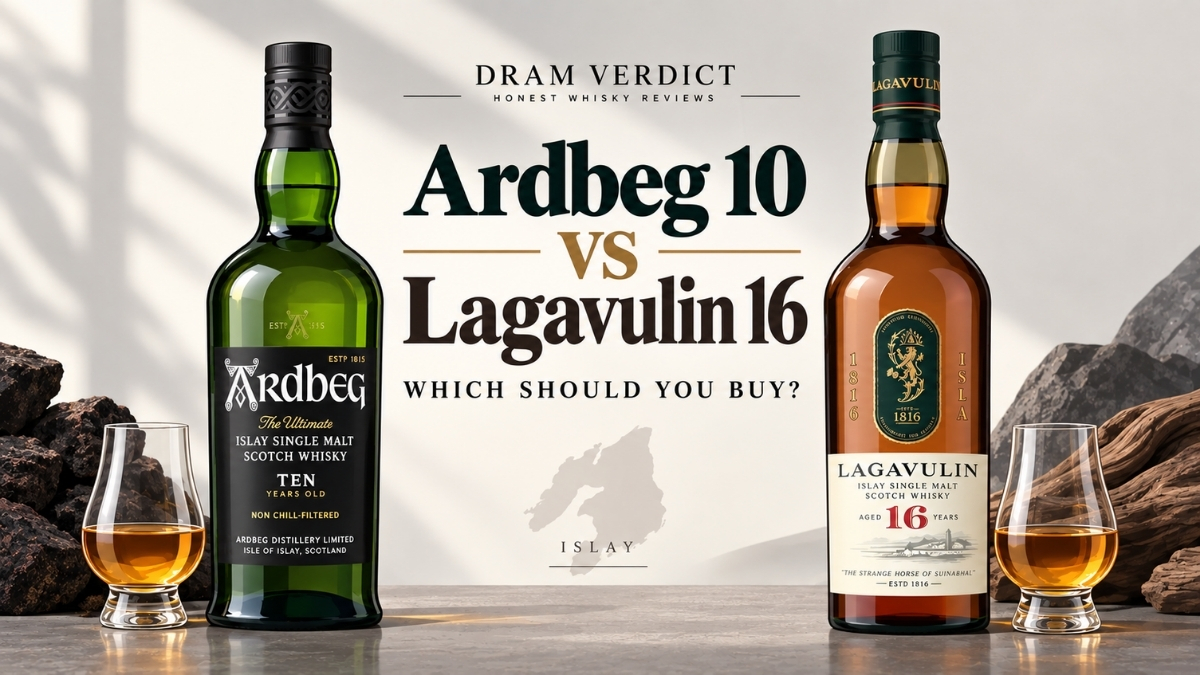
Ardbeg 10 and Lagavulin 16 are two of Islay’s best-known peated single malts, but they sit at very different points in Dram Verdict’s own tasting notes and scoring — and not just because one is six years older. Ardbeg 10 Year Old is younger, leaner and citrus-driven, with peat smoke that shows up immediately and never lets up. Lagavulin 16 Year Old is richer, fuller-bodied and more composed, with sixteen years in cask folding its smoke into something deeper and more layered. Dram Verdict scores Lagavulin 16 higher overall — 4.9 against Ardbeg’s 4.5 — but that gap doesn’t automatically make it the right bottle for every reader, and the two win in genuinely different places once you get past the headline number.
Quick Verdict
If you want maximum peat energy, brightness and a whisky that also makes a genuinely excellent highball, at a meaningfully lower price, Ardbeg is the more direct, accessible pick. If you want depth, complexity and a fuller-bodied dram built for slow, neat drinking, Lagavulin is worth the extra cost. This comparison breaks down exactly where each one wins, using Dram Verdict’s own first-hand tasting and serve-by-serve evidence rather than specs or reputation.
Quick Comparison
| Ardbeg 10 Year Old | Lagavulin 16 Year Old | |
|---|---|---|
| Age | 10 years | 16 years |
| ABV | 46% | 43% |
| Character | Smoky, Citrusy, Punchy | Peaty, Rich, Complex |
| Style | Direct, punchy, citrus-brightened | Rich, layered, composed |
| Sweetness | 2 / 5 | 3 / 5 |
| Fruit | 3 / 5 | 1 / 5 |
| Spice | 3 / 5 | 3 / 5 |
| Oak | 2 / 5 | 3 / 5 |
| Smoke / Peat | 5 / 5 | 4 / 5 |
| Body | 2 / 5 | 4 / 5 |
| Best neat | ✓ | |
| Best with water | ✓ | |
| Best on the rocks | Tie | |
| Best highball | ✓ | |
| Typical US price (750ml) | ~$55–$75 | ~$80–$98 |
| Dram Verdict score | 4.5 | 4.9 |
| Value | Excellent | Fair |
Notice that Smoke/Peat isn’t a tie here — Ardbeg actually rates higher on Dram Verdict’s own Flavor Profile. The rest of the table explains why Lagavulin still comes out ahead on overall score: it isn’t smokier, it’s richer, fuller and more mature. The sections below unpack exactly what that means in the glass.
The Biggest Difference: Youthful Energy vs. Mature Richness
The clearest difference in our tasting is not simply how much peat each whisky shows, but how that peat presents itself. Ardbeg’s Smoke/Peat rating of 5 out of 5 is actually the higher of the two on Dram Verdict’s Flavor Profile, and the tasting notes back that up: intense, immediate smoke that “announces itself immediately” and runs through the nose, palate and finish without backing off. Lagavulin rates 4 out of 5 on the same scale — still very high, but its own tasting notes describe the smokiness as “powerful yet restrained,” folded into honey, dark chocolate, oak and brine rather than sitting on top of everything else.
In short: by Dram Verdict’s own first-hand evidence, Ardbeg is the smokier whisky, and Lagavulin is the richer, more complex one. Those are different qualities, not the same quality at different volumes — and it’s why “which is smokier” and “which is the better whisky overall” have two different answers here.
Nose
Ardbeg’s nose is extremely intense right from the first sniff — vanilla and citrus sit alongside a wave of spice, smoke and sea air, with no easing into it. Lagavulin’s nose is rich and composed but carries real weight of its own: caramel and nuts against sulfur and medicinal notes, a smokiness that’s powerful yet restrained, plus fragrant wood, herbs, spice and a clear sea-salt edge. Ardbeg’s is the more immediate, in-your-face aroma; Lagavulin’s is the more layered one.
Palate
Ardbeg is very punchy on the palate, but the mouthfeel is surprisingly gentle — vanilla and malt meet lemon, smoke, a touch of seawater and white pepper, without ever feeling heavy. Lagavulin is oily and genuinely complex: honey and nuts meet soy sauce and medicinal notes, dark chocolate, spice, brine and oak, with the smoke running through all of it rather than sitting on top. This is where the body and complexity gap is most obvious — Ardbeg stays light and direct, while Lagavulin carries real weight and layering.
Finish
Both finish long. Ardbeg’s finish carries spice and smoky flavor together, firmly. Lagavulin’s finish carries toasty oak and a steady, unhurried smokiness. Length is essentially a tie; Ardbeg’s finish stays punchier and more direct, while Lagavulin’s stays deeper and more composed.
Which Is Smokier?
Ardbeg, by Dram Verdict’s own evidence — its Smoke/Peat rating of 5 out of 5 is a full point higher than Lagavulin’s 4 out of 5, and the tasting notes agree: Ardbeg’s smoke is immediate and doesn’t let up, while Lagavulin’s is described as “powerful yet restrained.” Raw phenol (PPM) figures are sometimes used to argue the opposite, but PPM measures the malted barley before distillation, not what actually shows up in the glass, and reliable current PPM figures for both distilleries’ malt aren’t consistently published or comparable — so this answer is based on finished-spirit tasting evidence, not a spec sheet. Lagavulin isn’t a “less smoky” whisky in any way that matters; its peat is simply more integrated into a richer overall structure rather than being the star of the show on its own.
Which Has More Body?
Lagavulin, clearly — its Body rating of 4 out of 5 reflects a genuinely oily, full mouthfeel, against Ardbeg’s Body of 2 out of 5. Ardbeg’s lighter body is a real style trait, not a shortcoming: it’s what keeps the whisky feeling punchy and energetic rather than heavy, and it’s a big part of why it works so well in a highball.
Which Is Richer?
Lagavulin, and it isn’t close. Its own Character is literally “Peaty, Rich, Complex,” and the tasting notes list an unusually long run of flavors — caramel, nuts, sulfur, medicinal notes, honey, soy sauce, dark chocolate, brine and toasted oak — all folded together rather than presented one at a time. Ardbeg’s flavor set is narrower and more direct: vanilla, citrus, smoke, a touch of pepper and sea air. Ardbeg isn’t simple, but Lagavulin is doing meaningfully more at once.
Which Feels More Mature?
Lagavulin, and its own Final Verdict says as much directly: “16 years in cask has rounded it into something layered rather than just aggressive.” Ardbeg’s Final Verdict draws the same contrast from its own side, describing itself as “punchier and lighter-bodied than Lagavulin 16.” Neither framing implies older is objectively better — Ardbeg’s youthful, vivid immediacy is a genuine style strength, not an underdeveloped version of what Lagavulin is doing. They’re aiming at different experiences: one vivid and direct, the other composed and integrated.
Which Is Better Neat?
Lagavulin, on the strength of the whisky itself rather than any single number. Its greater richness, complexity and fuller body give it more to unpack neat — honey, dark chocolate, brine and toasted oak all layered together and rounded out by sixteen years of maturation — and neither Review turned up a genuine liquid-level flaw in either bottle, so this isn’t a case of one whisky beating the other on a technicality. Dram Verdict’s overall Score (4.9 for Lagavulin, 4.5 for Ardbeg) reflects that same overall liquid quality rather than being a serve-specific neat rating on its own, and it lines up with the tasting evidence here. Ardbeg remains an excellent neat pour in its own right — brighter, leaner and more citrus-driven — and drinkers who want maximum peat energy over maximum complexity may prefer it neat regardless of the score gap.
Which Is Better With Water?
Lagavulin, rated Very Good against Ardbeg’s Fair. With water, Lagavulin’s deep sweetness and toastiness come through and the whole thing turns gentler, with the smoke folding into the rest of the flavor rather than fighting it. Ardbeg’s already-light body thins out further with added water rather than opening up — a much smaller splash works better for it than a full twice-up pour.
Which Is Better On the Rocks?
This one is a genuine tie — both are rated Good over ice. They get there differently, though: Ardbeg’s bitterness and spice come forward as its sweetness pulls back, making for a clean, refreshing pour, though it turns thin if the ice sits too long. Lagavulin’s sweetness pulls back and its oak comes forward instead, turning drier and more austere — still enjoyable, but a noticeably different, less rich experience than drinking it neat.
Which Makes the Better Highball?
Ardbeg, rated Excellent against Lagavulin’s Very Good. Ardbeg’s citrus, lighter body and punchy structure translate exceptionally well to soda, staying easier to drink than any of its other serves. Lagavulin’s own tasting notes are candid about the trade-off here: it’s “good, but the richness is largely lost” in a highball, with the iodine character coming through strongly instead. If you’re building a whisky highball as your main use case, Ardbeg is the clearer choice of the two.
Which Is More Approachable?
Neither is a gentle introduction to peated Scotch — both Reviews are explicit that they’re aimed at drinkers who already know they like heavily peated whisky, not newcomers. Between the two, though, Ardbeg is the slightly less demanding bottle: its lighter body and lower price make it easier to reach for casually or mix into a highball. Lagavulin’s dense, oily richness asks more patience and more of an existing taste for smoky Scotch, and its own Best For notes single it out as “not a first introduction to smoky whisky.”
Which Is Better for Peat Lovers?
Depends on which kind of peat lover you are. If you want peat to be the loudest thing in the glass, backed by citrus and energy, Ardbeg delivers that directly. If you want peat integrated into something deeper and more complex, with honey, oak and dark chocolate alongside it, Lagavulin is arguably the more complete expression of Islay character. Both belong to a wider island style than just these two bottles — for how they fit alongside names like Laphroaig, Bowmore and Kilchoman, see Dram Verdict’s guide to Islay Scotch brands.
Value
This is one area where the two Reviews land in genuinely different places: Ardbeg 10 is rated “excellent value” on its own Review, while Lagavulin 16 is rated only “fair.” That isn’t a judgment invented for this comparison — it’s carried straight from each bottle’s own separate Value assessment. Checking current US retail listings, Ardbeg 10 typically runs around $55–$75 for a 750ml bottle, while Lagavulin 16 typically runs closer to $80–$98 — a real gap, not a marginal one. Lagavulin’s higher price doesn’t make it a worse whisky (its liquid quality is rated higher than Ardbeg’s, not lower), but it does mean you’re paying a meaningfully larger premium for that extra depth and complexity, and Dram Verdict’s own Review already reflects that in its Value field rather than its Score. Pricing varies by retailer, state and region, so treat these as a current snapshot rather than a fixed number for either bottle.
Ardbeg 10 vs Lagavulin 16: Which Should You Buy?
Buy Ardbeg 10 if you want maximum peat energy with citrus and brightness; you prefer a lighter, leaner body; you drink highballs regularly; you want the stronger value proposition; or you’re not ready to spend $80+ on a single bottle.
Buy Lagavulin 16 if you want real depth, complexity and maturity in your peated whisky; you prefer a fuller, oilier body; you mostly drink neat or with a splash of water; or you’re willing to pay a real premium for what Dram Verdict rates as the more complete liquid.
Overall: Lagavulin 16 is the stronger whisky on pure liquid quality — richer, more complex, more mature, and scored higher by Dram Verdict (4.9 vs. 4.5) — but that’s not the whole buying decision. Ardbeg 10 is smokier by Dram Verdict’s own Flavor Profile, ties Lagavulin on the rocks, clearly wins the highball category, and does all of that at a meaningfully lower price with an “excellent” Value rating against Lagavulin’s “fair.” If you’re choosing purely on what tastes more accomplished neat, Lagavulin wins. If you’re weighing that against price, mixability and a brighter, more energetic style, Ardbeg has a genuine case of its own.
If you’re comparing further afield, Dram Verdict has also covered Ardbeg 10 vs Laphroaig 10 for another citrus-vs-medicinal Islay matchup, Lagavulin 16 vs Laphroaig 10 for how Lagavulin’s richer style compares directly against Laphroaig’s medicinal one, and Lagavulin 8 vs 16 for how the 16 compares against its own younger, punchier sibling.
- Is Lagavulin 16 better than Ardbeg 10?
-
On pure liquid quality, yes — Dram Verdict scores it higher (4.9 vs. 4.5) for its greater richness, complexity and maturity. But Ardbeg is smokier, cheaper, rated better Value, and makes a clearly better highball, so “better” depends on what you’re optimizing for.
- Which is smokier, Ardbeg 10 or Lagavulin 16?
-
Ardbeg, by Dram Verdict’s own Flavor Profile — 5 out of 5 on Smoke/Peat against Lagavulin’s 4 out of 5. Lagavulin’s smoke is just as real, but it’s more restrained and integrated into a richer overall structure rather than being the star of the glass.
- Which is richer, Ardbeg 10 or Lagavulin 16?
-
Lagavulin, clearly. Its own Character is “Peaty, Rich, Complex,” with a much longer list of flavors in play — caramel, nuts, honey, dark chocolate, brine and toasted oak — compared with Ardbeg’s more direct citrus-vanilla-smoke profile.
- Which has more body, Ardbeg 10 or Lagavulin 16?
-
Lagavulin, and it isn’t close — a Body rating of 4 out of 5 against Ardbeg’s 2 out of 5. Ardbeg’s lighter body is a deliberate style trait, not a flaw, and it’s a big part of why it works so well in a highball.
- Which is better neat, Ardbeg 10 or Lagavulin 16?
-
Lagavulin, on the strength of its greater depth, complexity and fuller body — not because of any flaw in Ardbeg, which neither Review found neat. Ardbeg remains an excellent, brighter and more citrus-driven neat pour for drinkers who prefer that style over maximum complexity.
- Which makes a better highball, Ardbeg 10 or Lagavulin 16?
-
Ardbeg 10, rated Excellent against Lagavulin’s Very Good. Lagavulin’s own tasting notes admit its richness is “largely lost” in a highball, while Ardbeg’s citrus and lighter body translate exceptionally well to soda.
Where to Buy
Ardbeg 10 Year Old
United Kingdom
Check Current Priceat The Whisky ExchangeLagavulin 16 Year Old
United Kingdom
Check Current Priceat The Whisky Exchange
We may earn a commission if you buy through our links. This never affects our scores.





Comments