
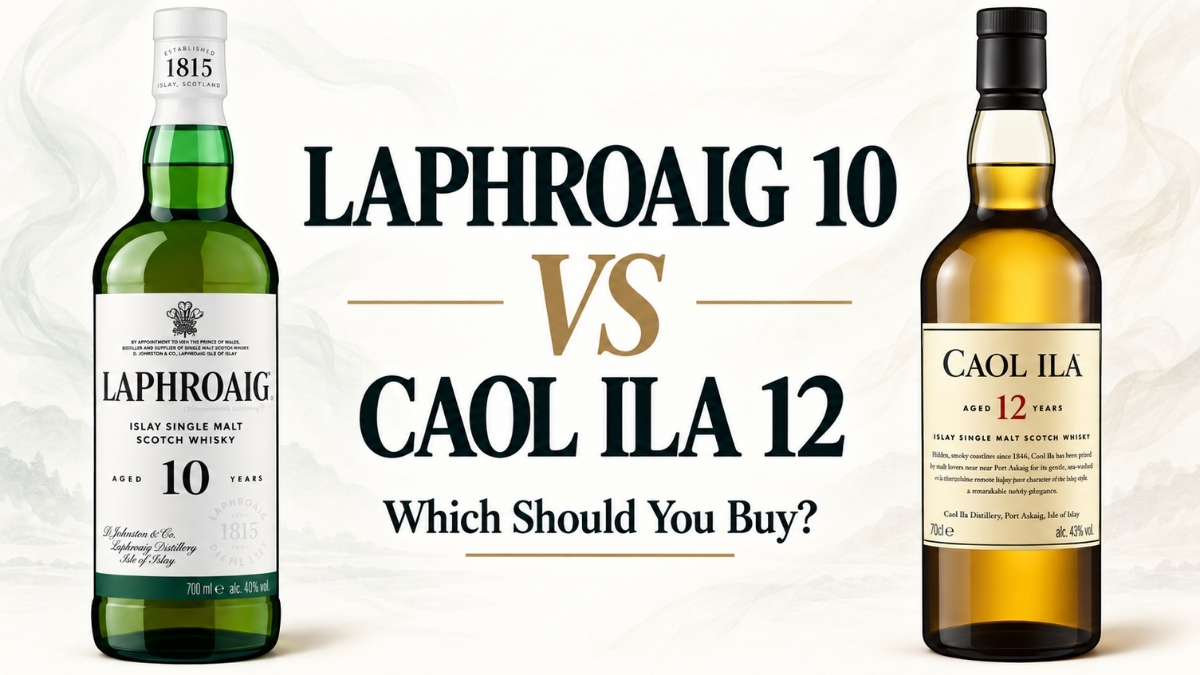
Laphroaig 10 and Caol Ila 12 are both real, unmistakably peated Islay single malts, but they land in almost opposite places on what that peat is supposed to do. Laphroaig 10 Year Old is built around a genuinely medicinal, iodine-like character that dominates the glass from the first sniff. Caol Ila 12 Year Old has no medicinal or iodine language anywhere in its own tasting notes at all — its own Review explicitly frames itself as built around “balance and complexity rather than overt punch or a medicinal edge.” Dram Verdict scores Caol Ila 12 higher overall — 4.7 against Laphroaig’s 4.3 — but that gap is about balance, not about which one is more authentically Islay.
If you specifically want — or are curious about — that iodine-driven, antiseptic style of Islay whisky, Laphroaig delivers it about as purely as any widely available bottle does. If you want real Islay peat that shares space with citrus, malt sweetness and floral notes rather than one dominant trait, Caol Ila is arguably the more complete whisky. This comparison breaks down exactly where each one wins, using Dram Verdict’s own first-hand tasting and serve-by-serve evidence rather than specs or reputation.
Quick Comparison
| Laphroaig 10 Year Old | Caol Ila 12 Year Old | |
|---|---|---|
| Age | 10 years | 12 years |
| ABV | 43% (US) / 40% (UK-EU) | 43% |
| Character | Medicinal, Smoky, Maritime | Smoky, Citrusy, Oily |
| Style | Medicinal, iodine-driven, oily | Balanced, composed, oily |
| Sweetness | 3 / 5 | 2 / 5 |
| Fruit | 1 / 5 | 3 / 5 |
| Spice | 2 / 5 | 3 / 5 |
| Oak | Tie (2 / 5) | |
| Smoke / Peat | 5 / 5 | 4 / 5 |
| Body | Tie (3 / 5) | |
| Best neat | ✓ | |
| Best with water | Tie | |
| Best on the rocks | Tie | |
| Best highball | ✓ | |
| Typical US price (750ml) | ~$43–$55 | ~$100–$110 |
| Dram Verdict score | 4.3 | 4.7 |
| Value | Tie (both Excellent) | |
Body, Oak, Water, Rocks and Value are all genuine ties. The real differences are concentrated in medicinal character, smoke intensity, and how much company the citrus and spice notes keep — which the sections below unpack using each bottle’s own tasting evidence.
The Biggest Difference: Medicinal Focus vs. Balanced Composure
Laphroaig’s Character is literally “Medicinal, Smoky, Maritime,” and its own tasting notes back that up without qualification — “a powerful, iodine-like edge dominates immediately,” described as “genuinely medicinal in a way that goes beyond generic smoke.” Caol Ila’s own tasting notes never use the words medicinal, iodine or antiseptic once, and its Final Verdict draws the contrast itself: it sits “closer in spirit to a more composed style of Islay peat” than to “a medicinal edge.” This isn’t a case of one bottle having a little more medicinal character than the other — Caol Ila’s own Review evidence doesn’t describe that character at all.
That’s the real axis this comparison turns on. Laphroaig picks one specific, polarizing trait and pushes it to the front of everything else. Caol Ila spreads real peat smoke across a wider set of flavors — citrus, malt sweetness, floral notes — so no single trait dominates the glass.
Nose
Laphroaig’s nose leads immediately with that iodine-like edge, backed by smoke, an antiseptic quality, sea air, leather and vanilla. Caol Ila’s nose carries strong smoke too, but with a genuine brightness underneath — lemon, malt and herbs sit alongside the peat rather than being buried by it. Both noses are unmistakably smoky Islay whisky; only one reads as medicinal.
Palate
Laphroaig is oily with a substantial, heavy richness — malt, vanilla, licorice and citrus meet oak and smoke, plus a rocky-shoreline saltiness and that same distinctive medicinal note carried through from the nose. Caol Ila is also oily in texture, with vanilla and malt meeting smoke, pear, herbs, citrus and sea air — “a real number of distinct notes working together” rather than one flavor sitting on top of everything else. Both are genuinely oily, full-textured whiskies (Body ties at 3 out of 5 for both); Laphroaig’s oiliness carries a dense, medicinal weight, while Caol Ila’s carries more moving parts at once.
Finish
Both finish long. Laphroaig’s finish carries smoke, bitterness and a spicy character together. Caol Ila’s finish is on the dry side, with refreshing peat and spice carrying on. Length is essentially a tie; Laphroaig’s finish stays heavier and more medicinal, while Caol Ila’s stays drier and cleaner.
Which Is Smokier?
Laphroaig, by Dram Verdict’s own Flavor Profile — 5 out of 5 on Smoke/Peat against Caol Ila’s 4 out of 5. That said, “smokier” and “more medicinal” are two different questions here: Laphroaig’s higher smoke rating and its medicinal identity are related but not the same thing, and Caol Ila’s smoke is still real and constant throughout the nose, palate and finish — it’s simply sharing space with citrus and malt sweetness rather than reading as more intense in isolation.
Which Is More Medicinal?
Laphroaig, and this isn’t a close call. Its Character literally includes the word “Medicinal,” and the iodine-like edge is described as dominating “immediately” in the nose and carrying through the palate and finish. Caol Ila’s own tasting notes contain no medicinal, iodine or antiseptic language anywhere, and its own Final Verdict explicitly positions itself away from “a medicinal edge.” If genuinely medicinal, antiseptic-style peat is what you’re after, Laphroaig is the only one of these two bottles that delivers it.
Which Is More Citrus-Forward?
Caol Ila, clearly — a Fruit rating of 3 out of 5 against Laphroaig’s 1 out of 5. Caol Ila’s own notes mention lemon, pear and citrus repeatedly across the nose and palate; Laphroaig’s citrus appears only once, on the palate, as one minor note among a much larger medicinal and oily profile. Caol Ila is also the spicier of the two (3 out of 5 versus 2), giving it a brighter, more animated flavor set overall.
Which Has More Body?
This is a genuine tie — both carry a Body rating of 3 out of 5, and both Reviews independently use the word “oily.” Laphroaig’s fuller texture reads as heavy and substantial, carrying its medicinal intensity; Caol Ila’s oily texture reads as complex rather than heavy, carrying a wider spread of flavors instead of concentrated weight. Same intensity, different character.
Which Is Richer and More Complex?
Caol Ila, by its own evidence. Its palate runs through vanilla, malt, smoke, pear, herbs, citrus and sea air all at once, and its Final Verdict names balance and complexity as “the whole point of this bottle.” Laphroaig’s flavor set is real and substantial — malt, vanilla, licorice, citrus, oak, smoke, saltiness — but it’s organized around one dominant medicinal trait rather than several competing for attention. Caol Ila is doing more things at once; Laphroaig is doing one thing more intensely.
Which Is Better Neat?
Caol Ila, on the strength of its balance and complexity rather than a single number. Neither Review found a genuine liquid-level flaw in either bottle neat, so the 0.4-point score gap (4.7 vs. 4.3) reflects Caol Ila juggling more distinct flavors without any of them crowding out the rest — not a weakness in Laphroaig. Laphroaig remains an excellent, highly distinctive neat pour in its own right, and drinkers who specifically want maximum medicinal character over maximum balance will likely prefer it regardless of the score gap.
Which Is Better With Water?
This is a genuine tie — both are rated Good. Both Reviews also make the same point about amount: Laphroaig’s body “holds up well even with water added” but “a light touch works better than a full twice-up pour,” while Caol Ila’s sweetness and balance hold up well too but “can feel a touch lacking at a full twice-up ratio.” A small splash suits both bottles better than a true 1:1 pour.
Which Is Better On the Rocks?
Another genuine tie — both are rated Excellent over ice, and each of this comparison’s own Reviews single out the rocks serve as one of its strongest. Laphroaig’s smokiness becomes more pronounced and real sweetness comes through as the liquid warms; Caol Ila’s own note calls its rocks serve “a genuine standout,” with fruitiness, smokiness and sweetness shifting like a gradient as the glass sits. Both bottles are built for ice.
Which Makes the Better Highball?
Caol Ila, rated Excellent against Laphroaig’s Very Good. Caol Ila turns dry and sharp with the smoke coming through cleanly, making it a genuinely good food-pairing option, though its own note admits some of its usual delicacy and complexity gets harder to pick out in this format. Laphroaig’s highball is still genuinely good — smoke and sea-air character hold their own against the fizz, and its own note calls it “one of the strongest serves” for the bottle specifically — but Caol Ila edges ahead by Dram Verdict’s rating.
Which Is More Approachable?
Caol Ila, and by a real margin here. Its own Best For notes describe it as built for “drinkers who want genuine Islay peat character without maximum intensity,” while Laphroaig’s own notes are blunt that it’s “not a good starting point for anyone who already knows they dislike medicinal or antiseptic notes.” Caol Ila’s balanced, less singular flavor profile gives a newer peat drinker more to hold onto than Laphroaig’s specific, polarizing medicinal identity.
Which Is Better for Peat Lovers?
Depends entirely on which kind of peat lover you are. If you want genuinely medicinal, iodine-driven peat as the main event, Laphroaig delivers that more purely than almost anything else widely available — its own Best For notes are written directly for “experienced peat drinkers who specifically enjoy… a genuinely medicinal, iodine-forward style.” If you want real Islay peat balanced by citrus and complexity rather than one dominant trait, Caol Ila’s own Final Verdict makes the case for itself. Both belong to a wider island style than just these two bottles — for how they fit alongside names like Ardbeg, Lagavulin and Bowmore, see Dram Verdict’s guide to Islay Scotch brands.
Value
Both bottles are rated “excellent value” on their individual Dram Verdict Reviews — but they sit at very different price points. Checking current US retail listings, Laphroaig 10 typically runs around $43–$55 for a 750ml bottle, while Caol Ila 12 typically runs closer to $100–$110 — Caol Ila costs close to double. Both still earn “excellent value” because each is judged against its own price and what it delivers there, not against each other: Laphroaig is excellent value as an affordable, highly distinctive medicinal Islay malt, and Caol Ila is excellent value as a genuinely complex, well-balanced Islay malt that happens to cost significantly more. If price matters most to you, Laphroaig is the clearly cheaper bottle; if you’re weighing pure liquid experience against each one’s own asking price, both hold up on their own terms.
Laphroaig 10 vs Caol Ila 12: Which Should You Buy?
Buy Laphroaig 10 if you want — or are curious about — genuinely medicinal, iodine-driven peat as the main event; you want the significantly cheaper of the two; or you prefer a more singular, intense style over balance.
Buy Caol Ila 12 if you want real Islay peat balanced by citrus, malt sweetness and complexity rather than one dominant trait; you want the slightly better highball; or you’re willing to pay meaningfully more for what Dram Verdict rates as the more complete liquid.
Overall: Caol Ila 12 edges ahead on pure liquid quality — its balance and complexity earn a 4.7 against Laphroaig’s 4.3 — but this comparison is really about style, not a quality gap. Body, water, rocks and Value are all ties; Laphroaig is smokier and dramatically cheaper, while Caol Ila is more citrus-forward, more complex and slightly better as a highball. The deciding factor for most readers will be simple: do you want medicinal, iodine-driven peat specifically, or real Islay smoke balanced by everything else? Laphroaig answers the first question better than almost any other widely available bottle; Caol Ila answers the second.
If you’re comparing further afield, Dram Verdict has also covered Ardbeg 10 vs Laphroaig 10 and Ardbeg 10 vs Caol Ila 12, which connect each side of this comparison to another core Islay bottle.
- Is Laphroaig 10 better than Caol Ila 12?
-
Not exactly — Caol Ila scores higher overall (4.7 vs. 4.3) for its balance and complexity, but Laphroaig is smokier, dramatically cheaper, and delivers a genuinely medicinal style Caol Ila doesn’t attempt. Which is “better” depends on whether you want medicinal intensity or balanced complexity.
- Which is more medicinal, Laphroaig 10 or Caol Ila 12?
-
Laphroaig, and it isn’t close. Its Character literally includes “Medicinal,” while Caol Ila’s own tasting notes contain no medicinal, iodine or antiseptic language at all — its own Final Verdict explicitly distances itself from “a medicinal edge.”
- Which is smokier, Laphroaig 10 or Caol Ila 12?
-
Laphroaig, by Dram Verdict’s own Flavor Profile — 5 out of 5 on Smoke/Peat against Caol Ila’s 4 out of 5. Caol Ila’s smoke is real and constant, but it shares the glass with citrus and malt sweetness rather than dominating it.
- Which is more approachable, Laphroaig 10 or Caol Ila 12?
-
Caol Ila, by a real margin. Its own Review is written for drinkers who want peat “without maximum intensity,” while Laphroaig’s own notes say it’s “not a good starting point” for anyone who dislikes medicinal or antiseptic notes.
- Which makes a better highball, Laphroaig 10 or Caol Ila 12?
-
Caol Ila, rated Excellent against Laphroaig’s Very Good. Caol Ila turns dry and sharp with clean smoke, though some of its usual complexity is harder to pick out; Laphroaig’s own note calls its highball “one of the strongest serves” for the bottle, just not quite as strong by Dram Verdict’s rating.
- Which offers better value, Laphroaig 10 or Caol Ila 12?
-
Both are individually rated “excellent value” by Dram Verdict, but Laphroaig is the significantly cheaper bottle — typically $43–$55 versus Caol Ila’s $100–$110. Each earns its rating against its own price point rather than against the other bottle.
Where to Buy
Laphroaig 10 Year Old
United Kingdom
Check Current Priceat The Whisky ExchangeCaol Ila 12 Year Old
United Kingdom
Check Current Priceat The Whisky Exchange
We may earn a commission if you buy through our links. This never affects our scores.









Comments