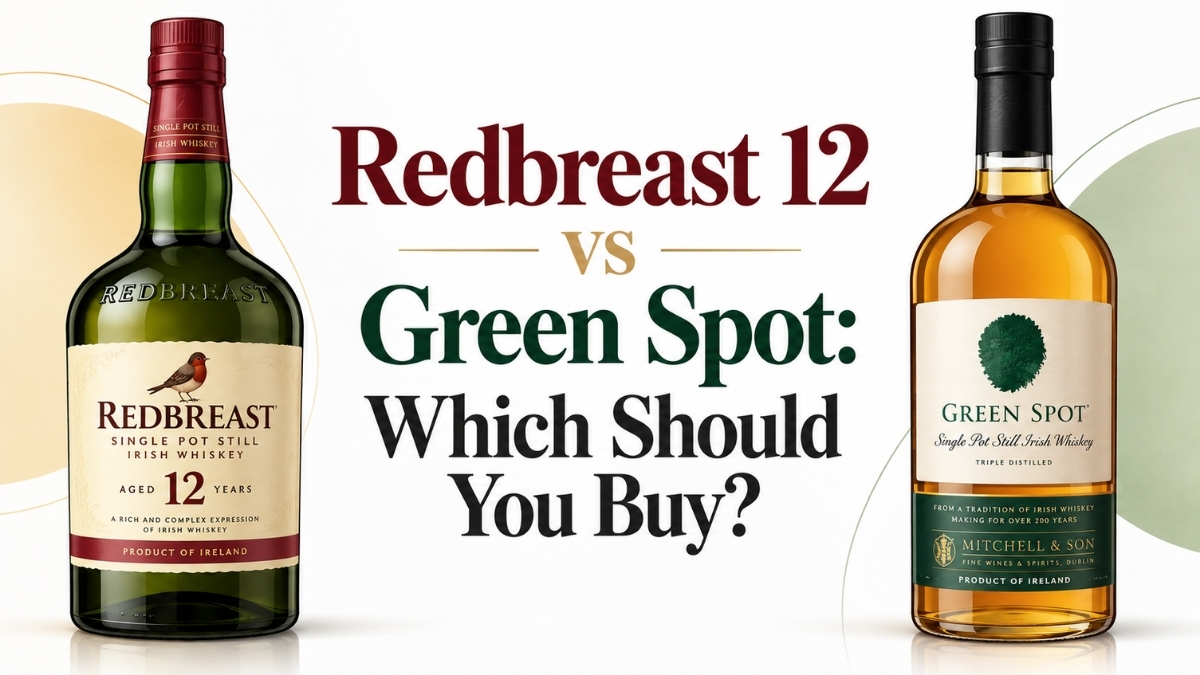
Redbreast 12 and Green Spot are both Single Pot Still Irish whiskeys made at Midleton Distillery, and they’re closer in profile than a simple “rich vs. light” framing suggests — they tie on sweetness, fruit, oak, smoke and body in Dram Verdict’s own Flavor Profile. Redbreast 12 is Kaz’s own favorite Irish whiskey, with a longer, more layered flavor list and a real edge in spice. Green Spot is genuinely complex for a whiskey with no age statement, built around a brighter, fruitier, creamier profile. Dram Verdict scores Redbreast 12 higher overall — 4.5 against Green Spot’s 4.3 — but the gap comes down to complexity and integration, not a fundamentally different flavor intensity.
Quick Verdict
Choose Redbreast 12 if you want a richer, spicier pot still whiskey with real depth, a longer finish, and a favorite-bottle level of polish — it also wins clearly on the rocks and as a highball. Choose Green Spot if you want a brighter, fresher, creamier take on the same style at a more consistent price, without giving up real complexity of its own. The sections below break down exactly where each one wins, using Dram Verdict’s own first-hand tasting and serve-by-serve evidence rather than specs or reputation.
Quick Comparison
| Redbreast 12 | Green Spot | |
|---|---|---|
| Age | 12 years | No age statement (7–10 year component whiskeys) |
| Cask | Bourbon and sherry casks | New bourbon, refill bourbon and sherry casks |
| ABV | Tie (40%) | |
| Character | Nutty, Spiced, Vanilla | Fruity, Creamy, Spiced |
| Style | Rich, balanced, layered | Bright, fruit-forward, creamy |
| Sweetness | Tie (3 / 5) | |
| Fruit | Tie (3 / 5) | |
| Spice | 3 / 5 | 2 / 5 |
| Oak | Tie (2 / 5) | |
| Smoke / Peat | Tie (0 / 5) | |
| Body | Tie (3 / 5) | |
| Best neat | ✓ | |
| Best with water | Tie | |
| Best on the rocks | ✓ | |
| Best highball | ✓ | |
| Typical US price (750ml) | ~$60–$77 | ~$60–$63 |
| Dram Verdict score | 4.5 | 4.3 |
| Value | Not rated | Fair |
Five of the six Flavor Profile axes are a genuine tie — this isn’t a comparison built on wildly different bottles. The real differences are concentrated in spice intensity, flavor complexity, serve performance, and how each Review treats Value, which the sections below unpack in detail.
The Biggest Difference: Layered Depth vs. Bright Simplicity
Redbreast’s own tasting notes run through nuts, dried fruit, berries, vanilla, spice, malt, ginger, apricot and wood across the nose, palate and finish — a genuinely long list of distinct flavors, all held together in what Kaz’s own Final Verdict calls “one of the most complete, well-balanced whiskies I’ve had.” Green Spot’s own notes are real but narrower: malt, vanilla, green apple, lemon, spice and oak. Both are legitimately complex for their category — Green Spot’s own Review specifically praises how complex it is “despite being non-age statement” — but Redbreast is doing more things at once.
That’s most of the story here: this isn’t one bottle being smoky and the other not, or one being sweet and the other dry — five of six Flavor Profile axes are literal ties. The gap is in how many distinct flavors each one is layering together, and how spicy the result is.
Some of that contrast is reflected in how each whiskey is put together. Redbreast 12 carries a 12-year age statement and is matured in a mix of bourbon and sherry casks, while Green Spot is a non-age-statement whiskey matured across new bourbon, refill bourbon and sherry casks. In our tasting, Redbreast came across as more concentrated and layered, while Green Spot showed a brighter, lighter-footed profile.
Nose
Redbreast’s nose leads with nuts and dried fruit, joined by berries and a warm vanilla sweetness, with a light spice note underneath. Green Spot’s nose is complex for a whiskey with no age statement — malt and vanilla lead, with green apple sitting alongside. Both noses share a vanilla base; Redbreast’s reads as richer and more fruit-driven toward dried fruit and berries, Green Spot’s as brighter and more toward fresh orchard fruit.
Palate
Redbreast is oily in texture, complex but delicate — malt and vanilla lead, with spice, ginger and apricot layered through, and nuts returning underneath. Green Spot is creamy and soft, with real body behind it — malt, green apple and lemon carry through, joined by spice and oak. Both share a genuinely full, oily-to-creamy texture (Body ties at 3 out of 5 for both); Redbreast’s palate simply has more distinct flavors moving through it at once.
Finish
Redbreast’s finish is slightly sweet and sour, turning woody and spicy, and lingers for a long time — Kaz’s own Final Verdict singles out a finish “that keeps changing instead of fading” as a specific reason he keeps coming back to this bottle. Green Spot’s finish is dry, with oak and spice taking the lead and a touch of bitterness, kept in check by a strong fruity sweetness. Both finish long; Redbreast’s keeps evolving through more stages, while Green Spot’s settles into a steadier dry-and-sweet balance.
Which Is Spicier?
Redbreast 12, by Dram Verdict’s own Flavor Profile — 3 out of 5 on Spice against Green Spot’s 2 out of 5. Redbreast’s own palate and finish both carry ginger and a distinct spicy character through to a genuinely spicy, woody finish, while Green Spot’s spice is real but plays a smaller supporting role alongside its brighter fruit.
Which Is Fruitier?
This is a genuine tie — both carry a Fruit rating of 3 out of 5. The style differs more than the intensity: Redbreast’s fruit reads as dried fruit, berries and apricot, sitting inside a richer, spicier whole. Green Spot’s fruit reads as green apple and lemon, brighter and more upfront against a lighter overall spice presence. Neither is “more fruity” by Dram Verdict’s own data — they’re differently fruity.
Which Has More Body and Texture?
Another genuine tie — both carry a Body rating of 3 out of 5. Redbreast’s own Review describes it as “oily in texture, complex but delicate,” while Green Spot’s is “creamy and soft, with real body behind it.” Both are full-feeling whiskeys rather than thin ones; Redbreast’s oiliness carries more layered flavor through it, while Green Spot’s creaminess feels softer and rounder.
Which Is More Complex?
Redbreast 12, and this is really the core of the whole comparison. Its own tasting notes list nuts, dried fruit, berries, vanilla, spice, malt, ginger, apricot and wood across the nose, palate and finish, described in its own Final Verdict as “one of the most complete, well-balanced whiskies I’ve had.” Green Spot is genuinely complex in its own right for a non-age-statement whiskey — that’s explicitly one of its own Review’s strengths — but its flavor list (malt, vanilla, green apple, lemon, spice, oak) is shorter. Redbreast is doing more at once; Green Spot is doing a slightly narrower range with real polish.
Which Is More Approachable?
This one is genuinely preference-dependent rather than a clean win for either bottle — and it cuts against the usual assumption that Green Spot is automatically the easier entry point. Redbreast’s own Review calls it “one of the first bottles I’d point you toward” for someone new to single pot still whiskey, and explicitly notes its character is “spice and balance rather than punch.” Green Spot’s own Review makes a similar claim from its side, calling itself “easy to recommend to someone new to pot still whiskey without asking much of them.” Both are positioned by Kaz as legitimate starting points into the category — they just start you off in different directions, one spicier and more layered, one brighter and creamier.
Which Is Better Neat?
Redbreast 12, on the strength of its complexity and integration rather than a single number. Neither Review found a genuine liquid-level flaw in either bottle neat, so the 0.2-point score gap (4.5 vs. 4.3) reflects Redbreast layering more distinct flavors together through a finish that keeps developing — not a weakness in Green Spot. Green Spot remains an excellent, genuinely complex neat pour for a non-age-statement whiskey, and drinkers who want a brighter, less spice-driven style over maximum layering may prefer it regardless of the score gap.
Which Is Better With Water?
This is a genuine tie — both are rated Very Good. Redbreast’s own note says the flavor “doesn’t lose definition” with water added, and the aroma opens up nicely. Green Spot opens up too with a small splash, turning sweeter and more fruity, though a full, equal-parts pour is too much for it and lets acidity come forward instead. Both reward a light touch with water; neither needs it to taste good neat.
Which Is Better On the Rocks?
Redbreast 12, rated Excellent against Green Spot’s Very Good. Over ice, Redbreast’s sweetness settles and spice comes forward, with an even creamier mouthfeel — a genuine step up from neat. Green Spot’s rocks serve is also strong: spice comes forward first, then sweetness and fruit build as the ice melts. Both perform well on ice; Redbreast’s own rating is simply the higher of the two.
Which Makes the Better Highball?
Redbreast 12, rated Good against Green Spot’s Fair — though neither bottle is really built for this format. Redbreast’s own note is candid about it: “works fine as a highball, but this isn’t the bottle you need for that job — a lighter whisky serves refreshment better.” Green Spot fares worse here, with its own note admitting the soda’s carbonation overwhelms its character and you lose a real amount of what makes the bottle worth choosing in the first place. If a highball is your main use case, neither of these is the ideal pick, but Redbreast holds up somewhat better.
Value
This row needs a direct explanation rather than a simple comparison: Green Spot is rated “fair” Value on its own Review, while Redbreast 12 currently has no stored Value rating at all — it isn’t rated “excellent,” “fair,” or “overpriced,” it’s simply blank. Redbreast’s own Final Verdict does say, in prose, that “at its current price I think the experience in the glass earns what’s being asked,” which reads as a positive view of its value — but that’s first-hand commentary, not a formal Value rating, and Dram Verdict doesn’t invent one here to force a comparison. Checking current US retail listings, Redbreast 12 typically runs from about $60 to $77 depending on retailer and any sale pricing, while Green Spot typically runs a tighter $60 to $63. Green Spot is the more consistently priced of the two; Redbreast has a wider range depending on where you shop, and can come in noticeably higher than Green Spot at full price.
Redbreast 12 vs Green Spot: Which Should You Buy?
Buy Redbreast 12 if you want a spicier, more layered pot still whiskey with real complexity; you drink on the rocks or want a genuinely good highball option; or you want Kaz’s own favorite Irish whiskey and don’t mind paying more depending on where you shop.
Buy Green Spot if you want a brighter, fruitier, creamier take on single pot still whiskey; you want a more consistently priced bottle; or you want something genuinely complex for a non-age-statement whiskey without Redbreast’s heavier spice.
Overall: Redbreast 12 edges ahead on pure liquid quality — its layered complexity and evolving finish earn a 4.5 against Green Spot’s 4.3 — but this is a close comparison built on style and depth, not a rout. The two tie on sweetness, fruit, oak, smoke and body; Redbreast is spicier and wins clearly on the rocks and as a highball, while Green Spot holds its own with water and offers a more predictable price. Both are genuinely legitimate entry points into single pot still Irish whiskey, just in different directions — if you want maximum layering and don’t mind Redbreast’s price swinging higher at some retailers, it’s the easy recommendation; if you want a brighter, creamier, more consistently priced pot still whiskey, Green Spot is a real answer rather than a compromise.
For more on this category, see Dram Verdict’s guide to single pot still whiskey, or browse the full Irish Whiskey archive.
- Is Redbreast 12 better than Green Spot?
-
On pure liquid quality, yes — Dram Verdict scores it higher (4.5 vs. 4.3) for its greater complexity and layered finish. But the two tie on five of six Flavor Profile axes, and Green Spot offers a brighter, more consistently priced alternative in the same style.
- Which is sweeter, Redbreast 12 or Green Spot?
-
It’s a genuine tie — both carry a Sweetness rating of 3 out of 5 in Dram Verdict’s Flavor Profile. Redbreast’s sweetness leans toward dried fruit and vanilla, while Green Spot’s leans toward fresh green apple and a fruity finish.
- Which is spicier, Redbreast 12 or Green Spot?
-
Redbreast 12, with a Spice rating of 3 out of 5 against Green Spot’s 2 out of 5. Redbreast’s ginger and spice notes carry through to a genuinely spicy, woody finish.
- Which is better neat, Redbreast 12 or Green Spot?
-
Redbreast, by Dram Verdict’s own score (4.5 vs. 4.3). Neither Review found a genuine flaw in either bottle neat — the gap reflects Redbreast’s greater complexity and a longer-developing finish, not any weakness in Green Spot.
- Which is better for beginners, Redbreast 12 or Green Spot?
-
Both are positioned by Dram Verdict as legitimate starting points into single pot still whiskey — Redbreast’s own Review calls it one of the first bottles to try in the category, and Green Spot’s own Review says the same. They just start you off in different directions: Redbreast spicier and more layered, Green Spot brighter and creamier.
- Is Redbreast 12 worth the extra money over Green Spot?
-
Redbreast 12 currently has no formal Value rating from Dram Verdict, while Green Spot is rated “fair.” Redbreast typically costs somewhat more and its price varies more by retailer, but its own Review states the experience in the glass earns what’s being asked — it comes down to whether you want the extra complexity badly enough to pay for it.
Where to Buy
Redbreast 12 Year Old
United Kingdom
Check Current Priceat The Whisky ExchangeGreen Spot
United Kingdom
Check Current Priceat The Whisky Exchange
We may earn a commission if you buy through our links. This never affects our scores.





Comments