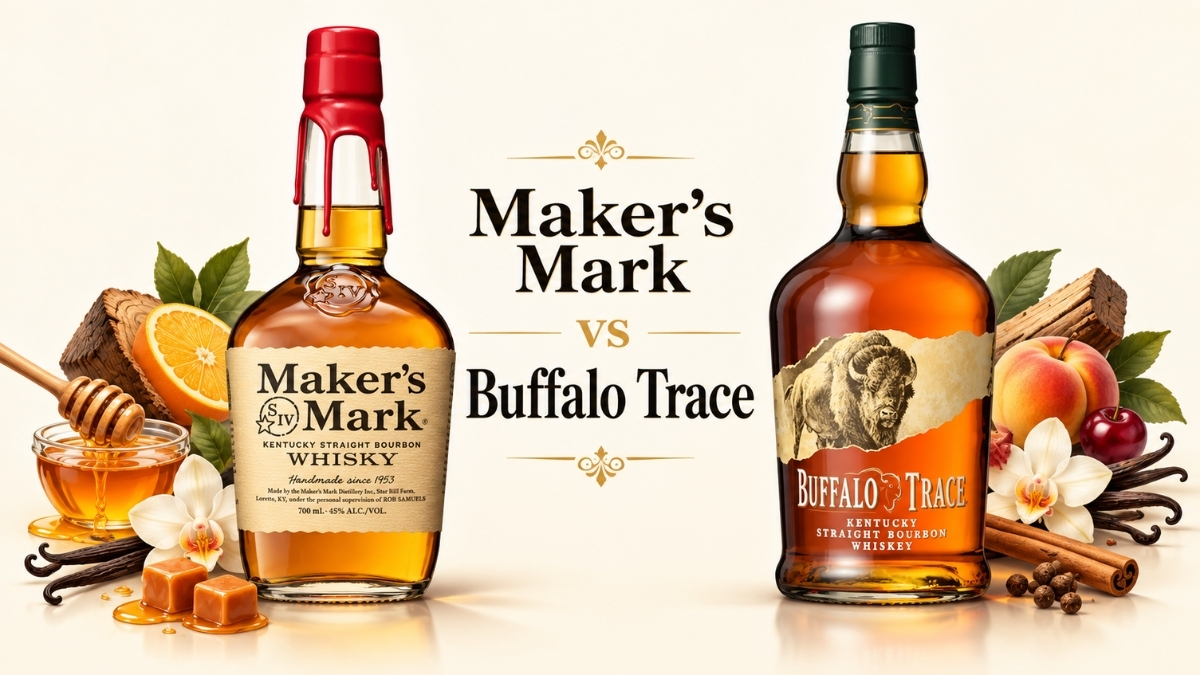
Maker’s Mark and Buffalo Trace are both Kentucky straight bourbons, both bottled at 45% ABV in the versions Kaz reviewed, and both easy-drinking enough that they often end up on the same shortlist. They’re built differently, though: Maker’s Mark uses soft red winter wheat instead of rye, while Buffalo Trace uses a recipe of corn, rye and malted barley. Kaz has tasted both first-hand — including side by side — and this comparison uses the same notes, scores and serve ratings as each bottle’s own Dram Verdict review.
Quick Verdict
Choose Buffalo Trace if you want the better bourbon: it scores 4.2 against Maker’s Mark’s 3.6, it’s exceptionally well balanced neat, with very little alcohol sting at 45%, and it’s excellent both on the rocks and as a highball. When Kaz tasted the two side by side, Buffalo Trace came out ahead on balance. Choose Maker’s Mark if you prefer a fuller, oilier texture with a little more barrel character (mostly over ice), or you’ll mostly drink it as a highball, where it’s every bit as good. The 0.6 gap comes almost entirely from how they drink neat.
Quick Comparison
| Maker’s Mark | Buffalo Trace | |
|---|---|---|
| Age | Tie (No age statement) | |
| ABV | 45% | 45% (bottling reviewed; 40% in some markets) |
| Type | Tie (Kentucky straight bourbon) | |
| Mash bill | Soft red winter wheat instead of rye | Corn, rye and malted barley (Mash Bill #1) |
| Character | Sweet, Smooth, Honeyed | Sweet, Vanilla, Balanced |
| Sweetness | Tie (4 / 5) | |
| Fruit | Tie (3 / 5) | |
| Spice | Tie (3 / 5) | |
| Oak | 3 / 5 | 2 / 5 |
| Smoke / Peat | Tie (0 / 5) | |
| Body | 3 / 5 | 2 / 5 |
| With water | Tie (Good) | |
| On the rocks | Good | Excellent |
| Highball | Tie (Excellent) | |
| Dram Verdict score | 3.6 | 4.2 |
Same sweetness, fruit and spice, and no smoke in either. Maker’s Mark rates higher on Oak and Body — yet Buffalo Trace scores higher overall, because what separates them is balance and integration, not intensity.
The Biggest Difference: Balance vs Body
On paper these two are close: both are sweet, both carry orange, apple, cinnamon and mint, and neither has a bold, distinctive personality. In the glass, Kaz’s side-by-side tasting is clear — Buffalo Trace came out ahead on balance, while Maker’s Mark came across grassier and earthier. Buffalo Trace’s strength is integration: vanilla, caramel and honey sweetness runs from nose to finish, with orchard fruit, cinnamon, mint and soft oak fitting together cleanly and the 45% alcohol handled with very little sting. Maker’s Mark has the fuller, oilier texture and, over ice especially, more barrel character, but neat its alcohol can feel sharp in a tulip glass and its finish is short. Buffalo Trace’s own limits are a fairly light body and modest complexity.
The grain recipes are a production fact, not a tasting shortcut. Maker’s Mark says it uses soft red winter wheat instead of rye, and Buffalo Trace makes its bourbon from Mash Bill #1, a recipe of corn, rye and malted barley; neither publishes the exact proportions. A wheated bourbon is often assumed to be the sweeter one, but in Kaz’s tasting both rate Sweetness 4 out of 5 — the wheat doesn’t make Maker’s Mark sweeter here.
Nose
Maker’s Mark leads with sweetness — vanilla, honey, orange, nuts and spice. Buffalo Trace is sweetness-led too, with a faint touch of alcohol: vanilla, caramel, cinnamon and orange. The two noses are close; Maker’s Mark adds honey and nuts, Buffalo Trace caramel and cinnamon.
Palate
Maker’s Mark is oily and easy for its strength, with caramel, orange, mint, apple, cinnamon and grain. Buffalo Trace is smooth and well balanced, fairly light despite its strong sweetness, with vanilla, honey, cinnamon, mint, banana, apple, corn and spice. Both share apple, cinnamon and mint; Maker’s Mark is the oilier and fuller, Buffalo Trace the lighter and more even, with banana and honey.
Finish
Maker’s Mark‘s finish is on the short side, with sweetness and spice rising through the nose. Buffalo Trace finishes with soft oak, spice and vanilla sweetness at moderate length. Buffalo Trace’s finish is the longer of the two.
Which Is Sweeter?
Neither — both rate Sweetness 4 out of 5, and sweetness is the first thing Kaz notices in each. Maker’s Mark’s sweetness is honeyed, with vanilla and caramel; Buffalo Trace’s is vanilla, caramel and honey, running consistently from nose to finish.
Flavor Profile Differences
Fruit: a tie at 3. Both have orange and apple; Buffalo Trace adds banana.
Spice: a tie at 3. Both show cinnamon and mint. In Maker’s Mark, spice rises through the nose on the finish; in Buffalo Trace it closes alongside soft oak.
Oak: Maker’s Mark wins, 3 out of 5 against 2. Its Oak rating reflects the whole drinking experience rather than the neat pour — barrel character comes through clearly over ice, while neat it’s a sweet bourbon first. Buffalo Trace’s oak is soft, and Kaz finds almost no barrel harshness in it neat.
Smoke / Peat: a tie at 0. Kaz found no smoke in either.
Body: Maker’s Mark wins, 3 against 2. Its texture is oily and carries its 45% gently; Buffalo Trace is fairly light, which Kaz counts among its limits.
Which Is Better Neat?
Buffalo Trace, clearly — and this is where the score gap comes from. Dram Verdict scores are judged neat and reflect only what’s in the glass: price, mixability, brand recognition and whether a retailer link exists play no part. Both are bottled at 45%, but they handle it very differently. Buffalo Trace shows only a faint alcohol note on the nose, with almost no sting, barrel astringency or bitterness on a smooth palate, and its sweetness, fruit, spice and soft oak fit together exceptionally well; its fairly light body, modest complexity and lack of standout individuality are what keep it at 4.2. Maker’s Mark is sweet, smooth and satisfying, with an oily texture, but neat its alcohol can feel sharp in a tulip-shaped glass (Kaz suggests a small shot glass instead), the finish is short, and there isn’t much distinctive character — which is why it scores 3.6. Neither is a whisky Kaz would call distinctive; Buffalo Trace is simply the more complete one neat.
Which Is Better With Water?
A tie — both are rated Good with water. Maker’s Mark turns gentle, sweet and fruity, with a smooth, easy texture. At a full 1:1, Buffalo Trace’s sweetness, fruit and oak all become more pronounced, though a smaller splash of water works better.
Which Is Better On the Rocks?
Buffalo Trace — rated Excellent on the rocks against Maker’s Mark’s Good. Over ice, Buffalo Trace’s sweetness stands out on the finish, the alcohol recedes, and it goes down cleanly with no quirks and no astringency from the barrel. Maker’s Mark changes more: bitterness and barrel character come through clearly and the sweetness closes up, leaving it a little astringent, though the sweetness returns as it sits.
Which Makes the Better Highball?
A tie — both are rated Excellent, and both lean sweet rather than sharp. Maker’s Mark makes a sweet, refreshing highball that’s easy for anyone to drink, and a squeeze of orange peel, the brand’s own highball serve, works well. Buffalo Trace’s sweetness and fruit come through more than crisp refreshment, giving a highball with plenty of flavor. Pick either; it’s Maker’s Mark’s strongest serve, and one of Buffalo Trace’s best.
Value
Neither review rates value yet, so this comparison doesn’t name a value winner. Prices change by market and over time, and price plays no part in either score — the 3.6 and 4.2 reflect what’s in the glass only. Each review page lists current retailer options where available.
Maker’s Mark vs Buffalo Trace: Which Should You Buy?
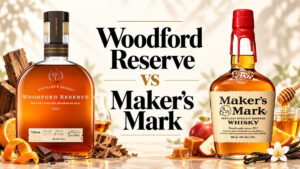
Buy Maker’s Mark if you want a sweet, honeyed bourbon with a fuller, oilier texture; you like a little more barrel character, which shows mostly over ice; or you’ll mostly drink it as a highball, perhaps with the brand’s orange-peel serve. Neat, it suits a small glass better than a tulip, and it’s less suited to anyone after a distinctive sipping bourbon. If you want a more refined, oak-led bourbon instead, see Woodford Reserve vs Maker’s Mark.
Buy Buffalo Trace if you want the better-balanced bourbon to drink neat; you like a sweet, vanilla-led profile with very little alcohol sting; or you want one bottle that’s excellent on the rocks and as a highball as well. It’s a good fit for bourbon newcomers and Scotch drinkers who usually find bourbon heavy, but less suited to anyone after a dry, spice-forward style or a bold personality.
Overall: Buffalo Trace is the better bottle. It scores 4.2 against Maker’s Mark’s 3.6, it’s exceptionally well balanced neat with very little alcohol sting, it came out ahead on balance when Kaz tasted the two side by side, and it’s the better of the two on the rocks. Maker’s Mark is the better choice if you prefer a fuller, oilier texture and a little more barrel character, or if a highball is how you’ll drink it — there, the two are equally good. Browse the Bourbon archive for more first-hand reviews.
- Is Buffalo Trace better than Maker’s Mark?
-
Yes — Buffalo Trace scores 4.2 against Maker’s Mark’s 3.6. It’s better balanced neat, with very little alcohol sting, and better on the rocks. Maker’s Mark has the fuller body and matches it as a highball.
- Is Maker’s Mark sweeter than Buffalo Trace?
-
Not in Kaz’s tasting — both rate Sweetness 4 out of 5, even though Maker’s Mark is a wheated bourbon. Maker’s Mark’s sweetness is more honeyed; Buffalo Trace’s is vanilla and caramel.
- Which is better neat, Maker’s Mark or Buffalo Trace?
-
Buffalo Trace. Neat, its alcohol barely stings and everything fits together cleanly, while Maker’s Mark’s alcohol can feel sharp in a tulip glass and its finish is short.
- Which makes a better highball, Maker’s Mark or Buffalo Trace?
-
Both are rated Excellent as a highball. Maker’s Mark is sweet and refreshing and works well with orange peel; Buffalo Trace is sweet and fruity, with plenty of flavor.
- Is Maker’s Mark smoother than Buffalo Trace?
-
Not neat. Maker’s Mark’s Character includes Smooth and its oily texture carries its 45% gently, but in a tulip glass its alcohol can feel sharp. Buffalo Trace, also 45%, shows almost no alcohol sting on the palate.
- Are Maker’s Mark and Buffalo Trace the same strength?
-
The bottlings Kaz reviewed are both 45% ABV (90 proof). Buffalo Trace is also sold at 40% in some markets, so check the label where you buy.