
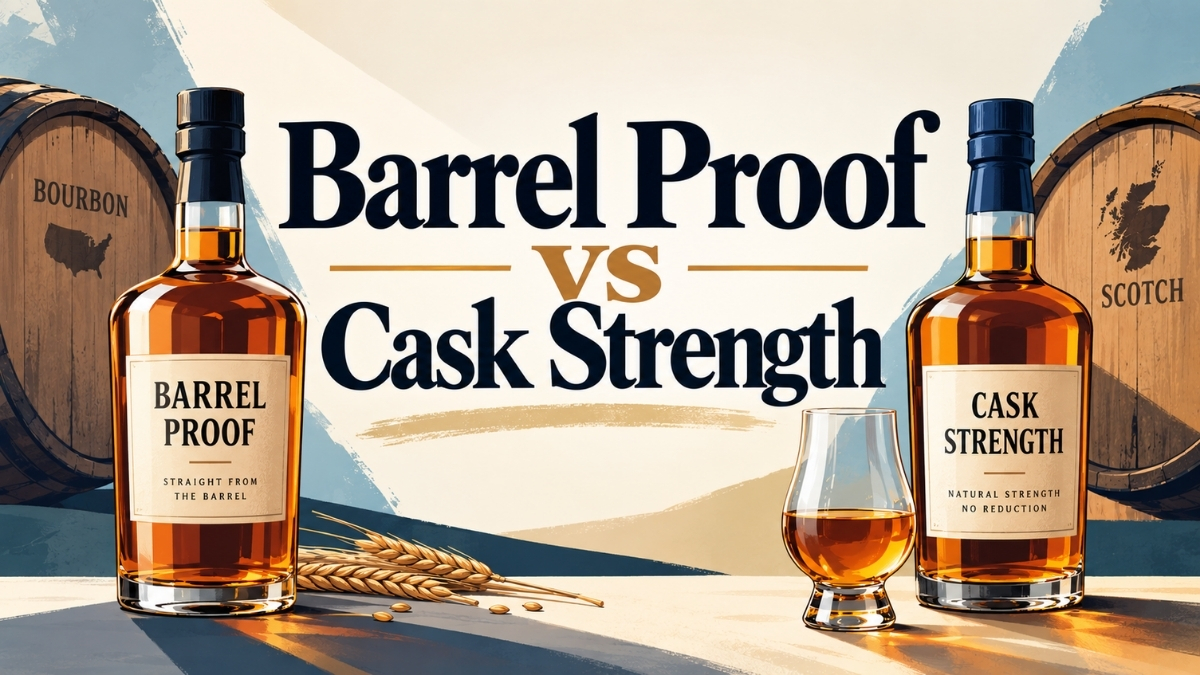
In everyday whisky conversation, “barrel proof” and “cask strength” mean the same basic thing: whisky bottled at or very close to the strength it reached during maturation, rather than being reduced to a conventional bottling strength. “Barrel proof” is the term you’ll see on American whiskey; “cask strength” is the term used in Scotch and most of the rest of the world. Neither label guarantees a specific ABV, and neither one is automatically the same as “single barrel” or “full proof” — both common points of confusion this guide clears up.
Barrel Proof vs Cask Strength: Are They the Same?
For practical purposes, yes — both describe whisky bottled without being diluted down after maturation. The difference is regional vocabulary and, in the U.S., a specific labeling nuance. Here’s how the three related terms actually compare:
| Term | Basic meaning | Proof reference point | Water reduction | Common context | Important caveat |
|---|---|---|---|---|---|
| Barrel Proof | Bottled at essentially the strength it left the barrel | Proof established at gauging for tax determination | None intended, but U.S. rules allow a small tolerance (see below) | American whiskey, especially bourbon | Bottling proof can legally run up to 2 degrees (1% ABV) below the gauged proof and still be labeled “Barrel Proof” |
| Cask Strength | Bottled at (or extremely close to) the strength it reached in the cask | Strength after maturation, before any post-maturation water addition | None permitted after maturation, per the official Scotch Whisky Technical File | Scotch and most international whisky | No published numeric tolerance in the way the U.S. term has one |
| Full Proof | Bottled at the same proof the spirit entered the barrel, not the proof it left at | Barrel entry proof | None between entry and bottling, by definition | A small number of American whiskey brands (e.g. 1792 Full Proof) | Not a general industry standard — it’s brand-specific labeling, and entry proof is usually higher than the proof the spirit ages down to |
Read that last row carefully: “Full Proof” isn’t just a stronger-sounding version of “Barrel Proof.” It’s referencing a different point in the process entirely, which is exactly why the two terms aren’t interchangeable — more on that below.
What Does Barrel Proof Mean?
In normal production, most whiskey is reduced with water after maturation to hit a target bottling proof — 80, 86, 90, whatever the brand’s standard strength is. A barrel-proof release skips that step: what came out of the barrel, aged, is what goes in the bottle, with no proof reduction.
That’s the plain-English version, and it’s accurate for how the term is used in practice. But there’s a labeling nuance worth knowing if you want to actually understand the number on the label rather than just take “barrel proof” at face value. Under U.S. federal rulings on distilled spirits labeling (ATF/TTB Ruling 79-9), “Barrel Proof” specifically means the bottling proof is not more than two degrees (1% ABV) lower than the proof established when the spirits were gauged for tax determination. In other words, the reference point is not the proof at which the whiskey originally entered the barrel:
Consumer shorthand: barrel proof = essentially bottled at barrel strength, with little or no proof reduction.
U.S. labeling reality: a small built-in tolerance exists — the bottle can legally run up to 1% ABV below the proof established at gauging — to account for minor natural variance between that measurement and bottling.
That tolerance is why you’ll sometimes hear that “barrel proof means zero water is added” isn’t quite precise as a legal matter — in practice, though, this is a narrow allowance for measurement variance, not a loophole distillers use to meaningfully dilute a whiskey and still call it barrel proof. Related label terms — “Original Proof,” “Original Barrel Proof,” and “Entry Proof” — mean something different again: that the proof at bottling matches the proof when the spirit went into the barrel in the first place, which is a separate claim from “Barrel Proof.”
What Does Cask Strength Mean?
“Cask strength” is the term Scotch and most non-American whisky uses for the same basic idea. It does have an official basis: the UK government’s Scotch Whisky Technical File states plainly that the alcoholic strength of “cask strength” Scotch Whisky must not be adjusted after maturation. So this isn’t just industry convention — it’s part of the regulatory framework that defines what can legally appear on a Scotch label.
What the Technical File doesn’t do is spell out a numeric tolerance the way the U.S. barrel-proof ruling does. In practice, cask-strength Scotch is understood to mean no water was added after the whisky came out of the cask, full stop — without the codified “up to 1% ABV” allowance that exists on the American side. The practical result for a drinker is the same either way: what’s in the bottle is essentially what matured in the wood, ABV and all — commonly landing anywhere from the high-40s to mid-60s% ABV depending on the cask, warehouse conditions, and maturation length, with no fixed minimum or maximum built into the term itself.
Barrel Proof vs Cask Strength: Why Are the Names Different?
Mostly, it’s regional convention rather than a meaningful production difference. “Barrel proof” is the term American distillers use — Kentucky bourbon in particular has built an entire subcategory around it. “Cask strength” is the term used across Scotch, Irish, and most other international whisky. Some brands also use “barrel strength” or “natural strength” as near-synonyms of “cask strength,” and you’ll occasionally see “barrel proof” used loosely outside the U.S. too. The one genuine difference that isn’t just vocabulary is the labeling nuance covered above: American “Barrel Proof” carries a specific, codified tolerance; the Scotch cask-strength definition doesn’t spell out an equivalent number. That’s a real distinction worth knowing — it just isn’t a reason to treat the two ideas as fundamentally different styles of whisky.
Barrel Proof vs Full Proof
This is where a lot of confusion creeps in, because “full proof” sounds like it should just mean “very strong” or be a synonym for barrel proof. It isn’t. The two terms reference different stages of the whiskey’s life:
| Stage | What it measures | Which label term references it |
|---|---|---|
| Entry proof | The proof of the spirit when it first goes into the barrel | Full Proof, Original Proof, Original Barrel Proof, Entry Proof |
| Proof at gauging (informally, “dump” or “exit” proof) | The proof of the spirit at the point it’s gauged for tax determination, generally around when the barrel is emptied after maturation | Barrel Proof, Cask Strength |
| Bottling proof | The proof actually in the bottle | Standard releases: usually lower than dump proof, after water is added. Barrel Proof / Cask Strength / Full Proof: intended to match the referenced stage, within any applicable tolerance |
Whiskey typically loses proof during maturation as it evaporates and interacts with the barrel (this varies by climate and warehouse, and isn’t universal, but it’s the common pattern for bourbon aged in Kentucky-style rickhouses). That means entry proof is usually higher than dump proof — so a “Full Proof” release, bottled at the barrel’s original entry strength, can actually be a higher-proof bottle than a “Barrel Proof” release from a similar mash bill and age. 1792 Full Proof is a useful real-world example: its own product description states it’s “bottled at its original 125 barrel entry proof, just as it was years ago when the barrels were first filled” — a direct, brand-stated reference to entry proof, not dump proof. That’s the specific distinction “Full Proof” is making, and it’s the reason the term deserves its own definition rather than being lumped in with “Barrel Proof.”
Does Barrel Proof Mean Single Barrel?
No — and this is one of the more common mix-ups. “Barrel proof” is a statement about strength (no proof reduction, within the tolerance above). “Single barrel” is a completely separate statement about blending: whether the bottle came from one individual barrel or from multiple barrels combined. A whiskey can be barrel proof and single barrel, barrel proof and a multi-barrel batch, standard proof and single barrel, or standard proof and a multi-barrel batch — the two labels describe different things and don’t imply each other.
Wild Turkey Rare Breed is a clean real-world example of a barrel-proof whiskey that is explicitly not single barrel (more on that bottle below). Wild Turkey’s own product page describes it as “a unique marriage of Wild Turkey 6, 8, and 12-year-old stocks” — a deliberate blend across three age groups, bottled at barrel/cask strength with no water added afterward. It’s barrel proof and a multi-barrel (batch) product at the same time. For a deeper look at what “single barrel” actually requires and how it differs from batch or small-batch production, see our Single Barrel vs Small Batch Bourbon guide.
Does Barrel Proof Always Mean Higher Proof?
Not automatically, though in practice it usually does. Standard bottling proof for most whiskey sits around 80–90 proof (40–45% ABV). Because barrel-proof and cask-strength releases skip that reduction, they typically land noticeably higher — commonly anywhere from around 100 proof up into the 130s, depending on the specific barrels used. But “barrel proof” isn’t a promise of a specific number; it’s a promise about process (no dilution), not a promise about how strong that particular barrel happened to be. A barrel that matured down to a modest strength and was bottled at that same strength is still legitimately “barrel proof,” even if the number itself isn’t especially high.
Does Barrel Proof Taste Better?
Not inherently, and it’s worth being honest about that rather than treating “undiluted” as automatically “superior.” What barrel proof and cask strength genuinely offer is concentration: more of the cask’s influence presented directly, without water pulling anything back, and the flexibility to dilute to your own preferred strength at the glass rather than having that decision made for you at the bottling line. That’s a real, legitimate advantage — but it’s a different thing from quality.
Higher proof can just as easily work against a whiskey: alcohol heat that’s poorly integrated becomes more noticeable rather than less, real flaws or imbalance in the underlying spirit get magnified rather than smoothed over, and the sheer intensity can be genuinely inaccessible for someone who isn’t used to drinking whiskey undiluted. A well-made 90-proof bourbon can be more balanced and more enjoyable than a poorly-balanced barrel-proof release from the same category. The format tells you how the whiskey was bottled — not how good it is.
How to Drink Barrel-Proof or Cask-Strength Whisky
Adding water to a barrel-proof or cask-strength whisky isn’t ruining it — it’s using the format exactly as intended. Bottling at full strength hands the dilution decision to the drinker instead of the distillery, so there’s no single “correct” way to drink one:
- Neat — the most direct read on what the cask actually produced, and worth trying first even briefly, before deciding whether to adjust it.
- A few drops to a small splash of water — often opens up aroma and can round off sharp alcohol heat, without pushing the whisky toward a diluted, standard-strength profile.
- Ice — dilutes more gradually and keeps the drink cold, which suits some high-proof whiskies well and mutes others’ character faster than a controlled splash of water would.
There’s no fixed rule for how much water is “right” — it depends on the specific whisky and your own preference, and it’s worth experimenting a little rather than assuming neat is always best just because the bottle was bottled at full strength.
Wild Turkey Rare Breed: A Real Barrel-Proof Example
To make this concrete, it’s worth looking at an actual barrel-proof bourbon we’ve tasted for Dram Verdict. Wild Turkey Rare Breed is bottled at 116.8 proof (58.4% ABV) — officially a marriage of Wild Turkey’s 6-, 8-, and 12-year-old stocks, with no water added after distillation. It’s a Kentucky Straight Bourbon Whiskey, and, as covered above, a multi-barrel batch product rather than a single barrel.
In our tasting, that strength showed up as real weight and power rather than raw alcohol heat: a genuinely spicy, oak-driven bourbon with real body, where the 58.4% ABV stayed surprisingly well-integrated instead of dominating the glass. That’s a good illustration of what a well-executed barrel-proof whiskey can offer — concentration and intensity that a standard-proof bottling wouldn’t deliver — without claiming that the proof alone made it better. Dram Verdict scored it 4.3 out of 5 (“Highly Recommended”); read the full Wild Turkey Rare Breed Review above for the complete tasting notes, including how it holds up with water, on the rocks, and as a highball.
Rare Breed is also a good reminder that “barrel proof” and “Kentucky Straight Bourbon” go hand in hand far more often than “cask strength” and Scotch do at the everyday retail level — American whiskey has simply built a much larger, more mainstream barrel-proof subcategory than Scotch has around cask strength, even though the specific labeling rules behind each term, as covered above, aren’t identical.
Barrel Proof vs Cask Strength FAQ
- Are barrel proof and cask strength the same thing?
-
In practical terms, yes — both describe whisky bottled without dilution after maturation. “Barrel proof” is the American term and carries a specific U.S. labeling tolerance; “cask strength” is the international/Scotch term, officially defined as strength that isn’t adjusted after maturation, without that same numeric tolerance spelled out.
- Does barrel proof mean no water is added at all?
-
Essentially, yes, but not with zero tolerance. Under U.S. labeling rules (TTB Ruling 79-9), “Barrel Proof” allows the bottling proof to run up to two degrees (1% ABV) below the proof established when the spirits were gauged for tax determination. That’s a narrow allowance for natural variance, not a meaningful dilution.
- Is cask strength stronger than barrel proof?
-
Neither term implies a specific ABV, so there’s no general rule that one is stronger than the other. The actual proof depends entirely on the individual barrel or cask — you have to check the bottle’s stated ABV either way.
- Is barrel proof the same as full proof?
-
No. Barrel Proof references the proof established at gauging for tax determination, generally around when the barrel is emptied after maturation. Full Proof references the proof when the spirit first went into the barrel (entry proof) — usually a different, often higher, number.
- Is barrel proof the same as single barrel?
-
No. Barrel proof is a statement about strength; single barrel is a separate statement about whether the bottle came from one barrel or a blend of several. A whiskey can be barrel proof and a multi-barrel batch at the same time — Wild Turkey Rare Breed is a real example.
- What proof is barrel-proof whiskey?
-
It varies by barrel. Most land somewhere between roughly 100 and the 130s proof, but there’s no fixed minimum or maximum built into the term — it depends on what that specific barrel actually matured to.
- Should you add water to cask-strength whisky?
-
You can if you want to — it’s not “ruining” the whisky. Bottling at full strength is meant to let the drinker choose the final proof rather than having it decided at the bottling line. A small amount of water can round off alcohol heat and open up aroma; how much (if any) comes down to personal preference.
Final Verdict
Barrel proof and cask strength are, for practical purposes, closely related ideas: whisky bottled at or very near its natural post-maturation strength rather than being reduced to a conventional bottling strength — though the two terms are not legally identical, since U.S. Barrel Proof carries its own TTB tolerance and Scotch cask strength follows its own separate rule. The real substance is in the details most articles skip — the U.S. barrel-proof labeling tolerance, the fact that cask strength has its own official (if less numerically specific) basis in the Scotch Technical File, and the way “full proof” and “single barrel” get wrongly folded into the same idea when they’re actually answering completely different questions. None of these labels tell you whether a whisky is good. They tell you how it was bottled — reading the label correctly just means you’ll know what you’re actually buying, and what to expect when you pour it.



Comments