
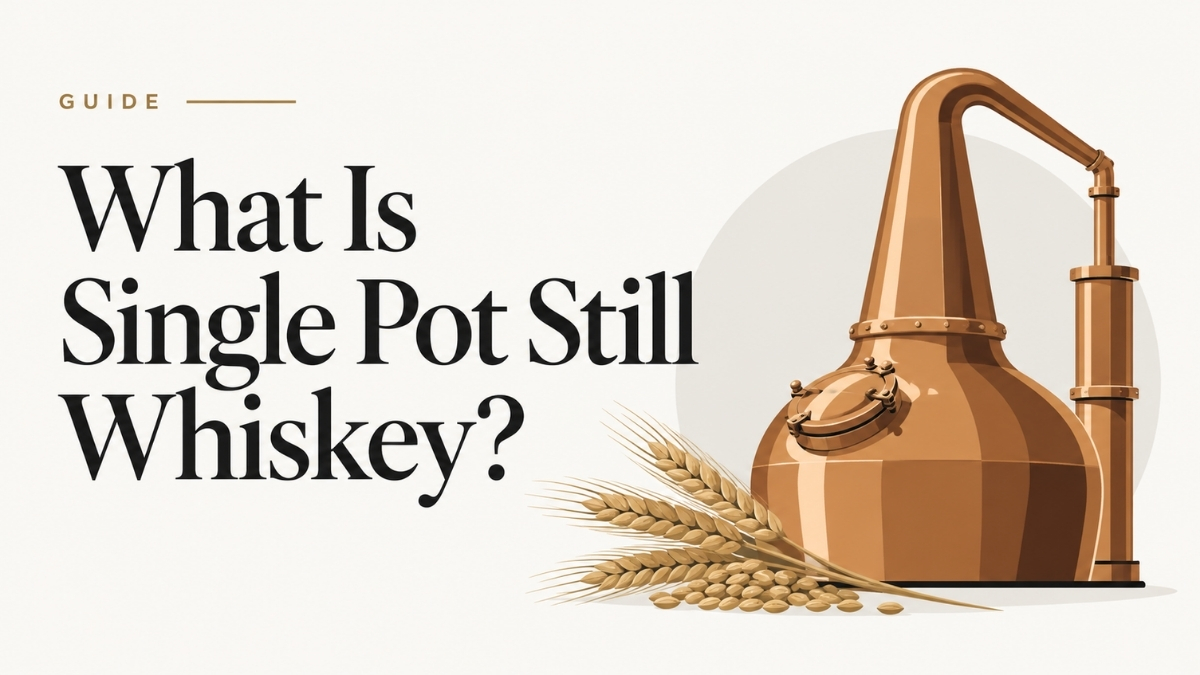
Single pot still whiskey is an Irish whiskey style made from both malted and unmalted barley, mashed, fermented and distilled at a single distillery. It’s not the same thing as single malt (which uses only malted barley), and “single” here doesn’t mean a single cask or barrel — it means the whole thing, from mashing through distillation, happened at that one site.
The Mash Bill Is What Actually Sets It Apart
Pot Still Irish Whiskey is one of the protected production categories within the Irish Whiskey Geographical Indication (GI) — which is exactly why the rule below is a legal specification, not just an industry convention. By the official Irish Whiskey Technical File, single pot still whiskey has to be distilled from a mash containing at least 30% malted barley and at least 30% unmalted barley, with up to 5% of other cereals like oats or rye allowed. That’s the real dividing line from single malt: Single Malt Irish Whiskey uses a cereal mash of 100% malted barley.
Unmalted barley is a required part of the current Pot Still Irish Whiskey specification, not an optional addition. The Technical File associates it with the style’s characteristic spice and a creamy mouthfeel — qualities single pot still whiskey is particularly known for.
That mash-bill rule isn’t necessarily fixed forever. Ireland’s Department of Agriculture, Food and the Marine ran a public consultation on the Irish Whiskey Technical File from 26 June to 4 September 2026, and the Irish Whiskey Association has formally proposed raising the “other cereals” allowance from 5% up to 30%, among other changes to the specification. Nothing has been adopted as of this writing — the 30/30/5 split above remains the current legal requirement — but it’s worth knowing this exact definition is under active government review as of September 2026.
“Single” Means One Distillery — Not One Barrel
Under Irish whiskey rules, the word “Single” can only be used on Pot Still, Malt, or Grain Irish Whiskey when every drop in the bottle was mashed, fermented and distilled at a single distillery. That’s a different sense of “single” than you’ll see on American bourbon labels, where “single barrel” refers to one specific cask, not one site. A single pot still whiskey can still combine different batches distilled at that one site — it just can’t include spirit distilled anywhere else.
What Single Pot Still Doesn’t Mean
A few mix-ups come up often enough to clear up directly:
- Pot-distilled doesn’t automatically qualify. Plenty of whiskey around the world is distilled in pot stills without meeting the mash-bill or single-distillery rules above. Pot still distillation alone doesn’t make something Single Pot Still Irish Whiskey.
- It isn’t another name for single malt. The mash bill — malted-only versus malted-and-unmalted — is the dividing line, not the shape of the still or the word “single” itself.
- Blended Irish whiskey isn’t Single Pot Still, even if pot still whiskey is part of the blend. Blends often include pot still whiskey as one component, but the “Single Pot Still” name is reserved for whiskey that’s entirely pot still, from one distillery, meeting the mash bill above.
- Is single pot still the same as single malt?
-
No. Single Malt Irish Whiskey is made from a mash of 100% malted barley. Single Pot Still Irish Whiskey uses a mix of at least 30% malted barley and at least 30% unmalted barley, with up to 5% other cereals allowed. Both must still come from a single distillery.
- Does “single” mean one cask or one batch?
-
No. “Single” refers to one distillery — the whiskey must be mashed, fermented and distilled at a single site. It can still be a mix of different batches distilled there, unlike “single barrel” on an American bourbon label, which refers to one specific cask.
- Is Redbreast 12 a single pot still whiskey?
-
Yes. Redbreast 12 is a triple-distilled Single Pot Still Irish Whiskey made at the Midleton Distillery in Co. Cork — one of the category’s best-known and most widely available examples.
- Is single pot still whiskey always Irish?
-
As a labeled category, yes — “Single Pot Still Irish Whiskey” is a protected style defined by Ireland’s Irish Whiskey Geographical Indication, so the name itself is tied to Ireland. Whiskey made elsewhere in pot stills from a similar mash isn’t entitled to use this specific category name.
- Is single pot still whiskey always triple-distilled?
-
No, even though it’s often described that way. Triple distillation is traditional and common, but the Irish Whiskey Technical File explicitly permits double distillation too. Triple distillation tends to produce a lighter aroma and sweeter, higher-strength spirit, but it isn’t a legal requirement.
Triple Distillation Is Traditional, Not Required
Triple distillation is traditional and widely used in Pot Still Irish Whiskey, but it is not mandatory; double distillation is also permitted. Where triple distillation is used, the Technical File says it produces a higher-strength final spirit and contributes to a lighter aroma and sweeter taste. You’ll often see it stated online as an absolute rule — it isn’t, and the Technical File itself says so directly.
Where the Style Came From
The story most often told is that Irish distillers started mixing in unmalted barley to get around a British tax on malted barley, introduced in 1785 and not repealed until 1855 — using less malt meant a smaller tax bill, and the unmalted grain in the mash became a defining trait rather than a cost-cutting afterthought. That’s the standard telling repeated across most whiskey histories; this article hasn’t independently verified the original 18th-century tax record itself, so treat it as the commonly accepted account rather than a footnoted legal fact.
What’s better documented is what happened next. Single pot still whiskey was the world’s most popular whiskey style through the 19th century, then fell into a long decline as cheaper blended whiskeys took over the market in the 20th. By 1980, only two pot still bottlings were left — Green Spot and Redbreast — and Redbreast itself went off the market in 1985, leaving Green Spot as the style’s sole survivor for several years before a slow revival, led largely by Irish Distillers, brought the category back.
What To Expect — And Where To Start
None of this tells you what’s actually in a specific glass — that depends on the individual whiskey, not just the category. But the unmalted barley’s spice and the pot still’s oily weight are common enough tendencies that they’re worth knowing before you buy: expect more body and a spicier, sometimes fruitier character than a typical single malt, rather than a lighter, more straightforwardly malty profile.
Redbreast 12, which I’ve tasted and reviewed, is a useful real-world reference point rather than a stand-in for the whole category. On the nose I got nuts and dried fruit with a warm vanilla sweetness and a light spice note; the palate was oily and complex, with malt, vanilla, spice, ginger and apricot layered through it; the finish turned woody and spicy and lingered for a long time. That’s one bottle’s profile, from one taster, not a guarantee of what every single pot still whiskey delivers — but it’s a real illustration of how the malted-and-unmalted mash bill can show up in an actual glass, and it’s genuinely one of the first bottles I’d point a newcomer toward.
Beyond Redbreast, Green Spot and Powers John’s Lane are two of the better-known current examples, both also distilled at Midleton. Green Spot has been produced since the early 1900s and is one of the style’s longest-surviving bottlings; Powers John’s Lane is matured in a mix of ex-bourbon and ex-sherry casks and bottled at 46% ABV. Neither has been tasted for Dram Verdict yet, so treat them as names worth knowing rather than a personal recommendation.
Single Pot Still Whiskey FAQ
Single pot still whiskey earns its own category name for a specific, checkable reason: a particular malted-and-unmalted mash bill, distilled entirely at one Irish distillery — not because of the still’s shape, a marketing story, or a single cask. Once you know that rule, the label makes a lot more sense, and a bottle like Redbreast 12 becomes a genuine reference point for what the style can deliver, rather than just another unfamiliar term on a shelf.







Comments