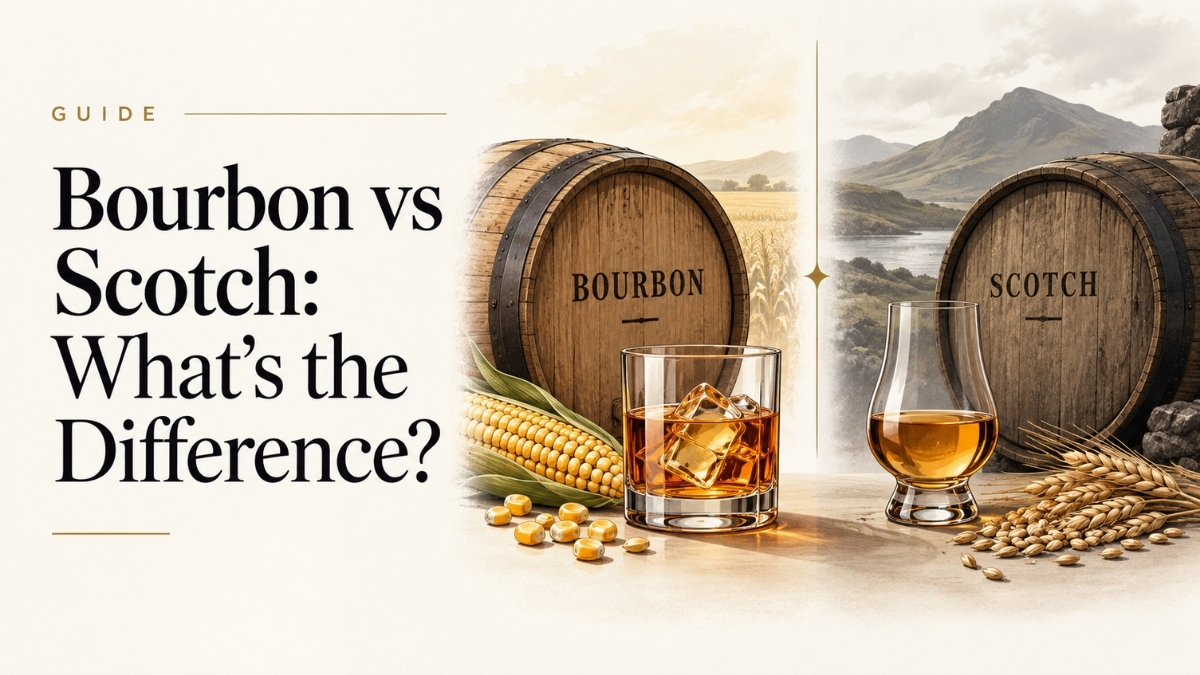
Bourbon and Scotch are both whisk(e)y, but they’re built on almost entirely different rulebooks. Bourbon is an American whiskey category, legally defined by the U.S. government: a corn-heavy mash, distilled and aged inside the country, matured in brand-new charred oak. Scotch is whisky made under Scottish law: distilled in Scotland from water and malted barley, aged for at least three years in Scotland, in oak casks that are very often previously used. Those differences in grain, cask and maturation rules are what actually separate the two — not a single flavor stereotype.
Bourbon vs Scotch at a glance
| Bourbon | Scotch | |
|---|---|---|
| Where it’s made | United States (any state) | Scotland only |
| Grain rules | At least 51% corn | Water and malted barley; other whole cereals allowed except in Single Malt |
| Distillation | Not exceeding 160° proof (80% ABV) | Below 94.8% ABV, so flavor from the grain survives distillation |
| Casks | New, charred oak containers only | Oak casks up to 700 liters; reuse is common but not a legal requirement |
| Minimum maturation | None for “bourbon”; 2+ years to be called “straight bourbon” | 3 years, matured in Scotland |
| Coloring/additives | None permitted | Only water and plain caramel coloring permitted |
| Bottling strength | No bourbon-specific minimum; 40% ABV is the general federal floor for whisky | Minimum 40% ABV |
| Common flavor tendencies | Vanilla, caramel, brown sugar, oak, baking spice | Varies enormously by category, distillery, cask and region |
| Dram Verdict example | Baker’s 7 Year Single Barrel | Clynelish 14 Year Old (a Single Malt Scotch, one style among several) |
That last row matters: Clynelish 14 is one Scotch, made in one of five legal Scotch categories. It doesn’t stand in for all of them, any more than one bourbon stands in for the whole bourbon category.
What makes a whiskey bourbon?
Under U.S. federal regulation (27 CFR 5.143), bourbon whisky has to be produced in the United States, from a mash of at least 51% corn, distilled at no more than 160° proof, and put into the barrel at no more than 125° proof. That barrel has to be new, charred oak — used barrels don’t qualify, which is why the bourbon industry is also a major supplier of used casks to Scotch and other whisky-producing countries.
Two things surprise people here. First, “bourbon” itself carries no minimum aging requirement at all — a spirit that meets the rules above is legally bourbon the moment it comes off the still, even before it touches a barrel long-term. Second, no coloring, flavoring or blending material of any kind is allowed in bourbon or straight bourbon; what’s in the bottle has to come entirely from the grain, the still and the barrel.
“Straight bourbon” is a further, optional designation: any bourbon that’s spent at least 2 years in that new charred oak can be labeled “straight.” Most bourbon on shelves is straight bourbon, but the two terms aren’t interchangeable — a bourbon aged 18 months is still bourbon, just not straight bourbon.
One common myth worth clearing up directly: bourbon does not have to be made in Kentucky. Kentucky produces the large majority of it by tradition and infrastructure, but the federal standard only requires the United States — bourbon is legally made in Texas, New York, Indiana and elsewhere too.
What makes a whisky Scotch?
Scotch is defined by the Scotch Whisky Regulations 2009. To use the name at all, a whisky must be distilled at a distillery in Scotland from water and malted barley (other whole cereals can be added, with one exception below), converted using only the grain’s own enzymes, fermented only with yeast, and distilled to below 94.8% ABV — a ceiling well below the near-neutral strength of something like vodka, specifically so the character of the raw materials survives distillation. It then has to mature for at least three years, entirely in Scotland, in oak casks no larger than 700 liters. The only things allowed to be added afterward are water and plain caramel coloring — nothing else.
The regulations also define five legal categories, and this is where the “Scotch must be 100% malted barley” idea goes wrong — that’s only true for one of them:
- Single Malt Scotch Whisky — malted barley only, no other cereals, distilled in pot stills at a single distillery. This is the only category where “100% malted barley” is actually the rule.
- Single Grain Scotch Whisky — made at a single distillery, but can include other cereals alongside the malted barley.
- Blended Malt Scotch Whisky — a blend of Single Malts from more than one distillery.
- Blended Grain Scotch Whisky — a blend of Single Grains from more than one distillery.
- Blended Scotch Whisky — a blend of one or more Single Malts with one or more Single Grains. Most of the world’s best-known Scotch brands are this category, including Johnnie Walker Black Label.
Clynelish 14 is a Single Malt Scotch — malted barley only, from one Highland distillery. Johnnie Walker Black Label sits in the other category: a Blended Scotch built from single malts and grain whiskies sourced across Scotland, including a touch of peated Islay character. That’s a real and specific style, not a stand-in for Scotch as a whole.
The biggest difference is the cask
Grain rules explain part of the split between the two categories, but the cask requirement is arguably the sharper line. Bourbon has to go into new, charred oak, every single time. That virgin wood gives up a lot, fast: vanilla, caramel and coconut compounds sit right at the surface of a freshly charred barrel, and there’s no previous filling to soften or compete with them. It’s a large part of why bourbon tends to read as sweeter and more oak-forward even at a young age.
Scotch regulation only specifies the wood (oak) and the size (up to 700 liters) — not what was in the cask before. In practice, most Scotch does go into previously-used casks, commonly ones that held bourbon or sherry, because a “tired” cask gives up less wood character and lets more of the spirit’s own flavor and the cask’s residual influence show through. But “commonly” isn’t “always” or “required” — a distillery could legally mature Scotch in new oak too, and the built-in variety of cask history is one reason Scotch flavor spans such a wide range even within categories that share the same grain rules.
Does bourbon taste different from Scotch?
In general terms, yes — but not for the reason people usually reach for. Bourbon commonly trends toward vanilla, caramel, brown sugar, oak and baking spice, largely for the new-charred-oak reasons above. Scotch doesn’t have one profile to trend toward at all: it spans fruit, honey, malt, wax, salinity, sherry-cask richness and, in some bottlings, smoke — depending on the distillery, the region, the cask history and whether peated malt was used.
That last point is worth being direct about: Scotch is not automatically smoky. Peat is a regional and stylistic choice, strongly associated with Islay in particular, not a requirement of the category. Clynelish 14 — a coastal Highland Single Malt — is a useful real example: its published Dram Verdict flavor profile carries no smoke or peat character at all, alongside honey, vanilla and oak notes. Lagavulin 16, an Islay Single Malt from the other end of the spectrum, builds its entire identity around that peat smoke instead. Baker’s 7, on the other side, is an oak- and spice-forward high-proof bourbon. Three real bottles, three very different profiles, and none of them is “the” flavor of its category.
Bourbon or Scotch: which should you try first?
There’s no objectively correct starting point — it comes down to what you tend to enjoy.
Start with bourbon if you tend to like:
- Sweeter, oak-driven profiles
- Vanilla, caramel and brown sugar notes
- A bolder, more assertive American oak character
Start with Scotch if you want:
- Broader variation from one bottle to the next
- Malt-driven, distillery-specific styles
- Access to fruit, honey, coastal, sherry-cask or peated styles depending on what you pick
Neither category is the “easier” or “more serious” one — they’re just built on different rules, which is exactly why it’s worth knowing the rules before deciding.
Two bottles that show the difference
Baker’s 7 Year Single Barrel Bourbon
Baker’s 7 is a single barrel bourbon (see the Single Barrel vs Small Batch Bourbon guide for what that means) bottled at a high 53.5% ABV, and it shows exactly the oak- and spice-forward character new charred oak tends to produce at that strength — Dram Verdict scored it 4.3 out of 5, oak and spice carrying through from nose to finish. Read the full Baker’s 7 Year Single Barrel Bourbon Review.
Clynelish 14 Year Old
Clynelish 14 is a 46% ABV Highland Single Malt Scotch with no smoke or peat in its profile at all — honey, vanilla and oak lead instead. Dram Verdict scored it 4.5 out of 5. Read the full Clynelish 14 Year Old Review.
These two bottles aren’t presented here as “the best starting points” for their categories — just as two real, independently reviewed examples of how differently the same broad idea, whisky, can turn out once grain, cask and maturation rules diverge this much.
- Is bourbon a type of Scotch?
-
No. They’re both whisk(e)y, but bourbon is a U.S.-regulated category and Scotch is a UK-regulated one, with different grain, cask and maturation rules. Neither is a subtype of the other.
- Is Scotch always smoky?
-
No. Smoke comes from peated malt, which is a regional and stylistic choice, not a legal requirement. Many Scotches, including Highland malts like Clynelish 14, have no smoke or peat character at all.
- Is bourbon always made in Kentucky?
-
No. Federal regulation only requires that bourbon be made in the United States. Kentucky produces most of it by tradition and infrastructure, but it isn’t a legal requirement.
- Does Scotch have to be made from barley alone?
-
Only Single Malt Scotch has to be 100% malted barley. Other Scotch categories, like Single Grain and Blended Scotch, can include other cereals alongside the malted barley that every Scotch must contain.
- Which is sweeter, bourbon or Scotch?
-
Bourbon commonly trends sweeter, largely because new charred oak gives up vanilla and caramel notes quickly. Scotch doesn’t have one sweetness level to compare against — it varies widely by category, cask and distillery.
- Why is it spelled bourbon whiskey but Scotch whisky?
-
It’s a spelling convention, not a rule difference. American and Irish whiskey is usually spelled with an “e”; Scotch, Japanese and Canadian whisky usually drop it. Both spellings refer to the same category of spirit.
The bottom line
Bourbon and Scotch diverge on grain, cask and maturation rules long before flavor ever enters the picture — and those rules, not a single sweet-vs-smoky stereotype, are what actually explain why the two categories taste as different as they do. For a real look at where each category lands, read the Baker’s 7 Year Single Barrel Bourbon Review and the Clynelish 14 Year Old Review, or browse the Bourbon and Scotch Whisky hubs for more.



Comments