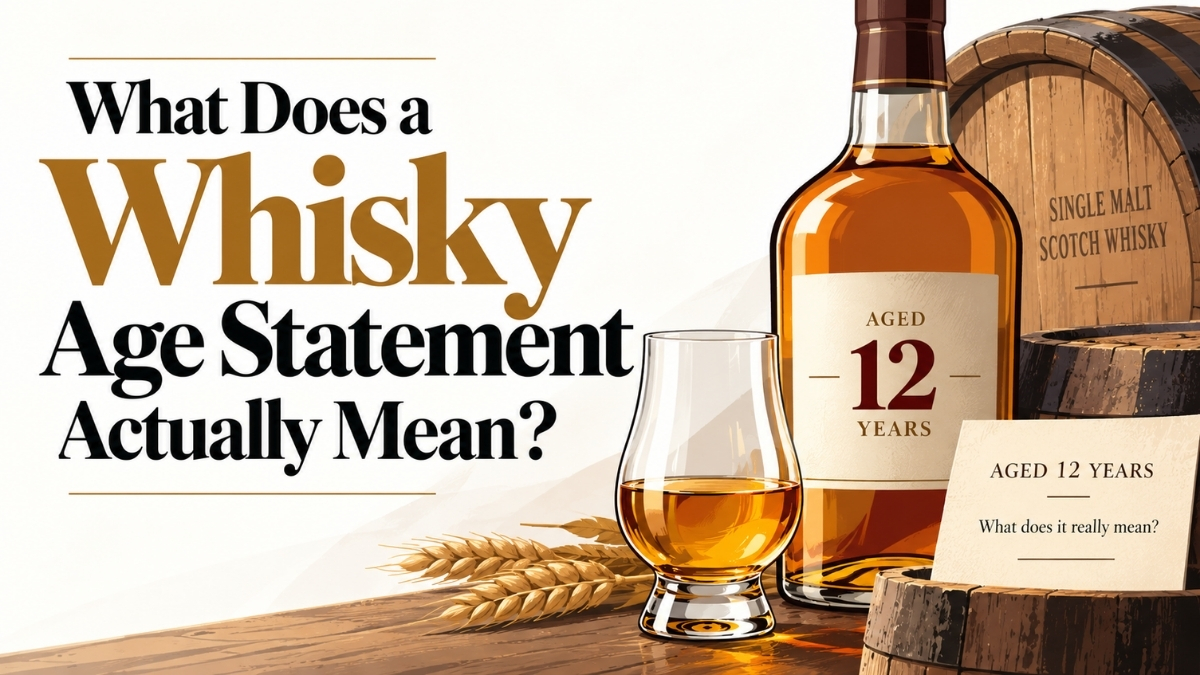
The number on a whisky label — “12 Years Old,” “18 Years Old” — tells you one specific thing: the youngest whisky used to make that bottle spent at least that long maturing in an oak cask. It says nothing about time spent in the bottle afterward, and by itself it says nothing about quality. Exact rules vary a little by country, but the core idea — the age statement reflects the youngest component, not an average and not the oldest — holds across Scotch, Irish and American whiskey alike.
Whisky age statements at a glance
| What it means | |
|---|---|
| What the number refers to | The youngest whisky used in the bottle, not an average and not the oldest component |
| Where the clock runs | Time in an oak cask only, between distillation and bottling |
| Time in the bottle | Doesn’t count toward the stated age at all, in any of the three categories covered here |
| NAS (“No Age Statement”) | The label simply doesn’t disclose an age — the whisky can still be older than most age-stated bottles |
| Does older mean better? | No — age is one input into flavor, not a quality score |
What does “12 years old” actually mean?
Most whisky sold today is a blend — not necessarily a “blended whisky” in the category sense, but a mix of casks from different fill dates, brought together to hit a consistent house style batch after batch. Say a bottling actually contains whisky from three casks: one filled 12 years ago, one 15 years ago, one 20 years ago. Under both UK/EU spirit drinks rules and U.S. federal regulation, if that bottle carries an age statement at all, it has to say “12 Years Old” — the age of the youngest component, full stop. The 15- and 20-year-old casks in the blend don’t get averaged in, and the label can’t round up.
That doesn’t mean every age-stated bottle is secretly a blend of wildly different ages — plenty are made almost entirely from casks filled around the same time. But whenever multiple ages are involved, the rule is the same everywhere this article covers: name the youngest, not the average.
Does whisky keep aging in the bottle?
No — not in any legal or meaningfully chemical sense. U.S. federal regulation defines “age” outright as the time between distillation and bottling that the spirit spent in oak barrels; once it’s in glass, that clock has already stopped. The same principle holds for Scotch and Irish whiskey: maturation is a cask-and-warehouse process, and nothing in an EU/UK spirit-drinks age statement counts time spent sealed in a bottle.
Practically speaking, whisky in a properly sealed, upright bottle is extremely stable — it isn’t quietly getting “older” or better on a shelf the way wine can. Very long-term storage can bring slow, minor changes (evaporation past a poor seal, some oxidation once a bottle is opened and air gets in), but that’s condition, not additional maturation, and it isn’t something to expect or plan around with a sealed bottle.
What does NAS whisky mean?
NAS means exactly what it says: No Age Statement. Nothing more. It doesn’t mean young whisky, and it doesn’t mean the underlying category’s minimum maturation law has been waived — a Scotch with no age statement still had to mature at least three years in Scotland, an Irish whiskey still had to mature at least three years on the island of Ireland, and an American whiskey under four years old is actually required to disclose its age rather than go NAS.
What NAS actually buys a distillery is blending flexibility: it can combine casks of different ages — including some considerably older than a comparable age-stated release — without being locked into naming whichever cask happens to be youngest in the mix. That flexibility gets used for all kinds of reasons, from genuine stylistic choice to managing limited stock of older casks. Neither of those reasons makes an NAS bottle automatically worse, and neither makes it automatically a bargain — it just means the exact age composition isn’t disclosed on the label.
Age statement rules differ by whisky type
| Minimum maturation | Age statement required? | Youngest-component rule? | |
|---|---|---|---|
| Scotch | 3 years, in oak, in Scotland | Optional | Yes |
| Irish whiskey | 3 years, in wooden casks, in Ireland | Optional | Yes |
| American whiskey (incl. Bourbon) | None for the base category; 2 years for “straight” | Mandatory only if aged under 4 years (unless bottled in bond) | Yes, for blends |
The practical upshot: a Scotch or Irish whiskey can always legally carry an age statement or skip it, since both categories already clear a 3-year floor either way. American whiskey is the outlier — cross the 4-year mark and the age statement becomes optional (which is why so much well-aged bourbon simply doesn’t bother stating one), but dip under it and the label is required to say so.
Does older whisky taste better?
More time in the cask generally means more contact with the wood: more color, more oak-derived vanilla and spice, more oxidation, and more evaporation concentrating what’s left behind. Those are real effects, and they’re a large part of why older whisky often reads as richer or more integrated.
But wood contact has diminishing returns and then negative ones. Push a cask too far and the oak can dominate — dry, bitter tannin instead of balanced sweetness — while the character of the original spirit that made the distillery distinctive in the first place fades out underneath it. A whisky can absolutely be too old for its own cask. Age is an input into the final flavor, not a scoreboard, which is exactly why Dram Verdict scores are never based on how old a whisky is.
Six Dram Verdict examples
Clynelish 14 Year Old
The “14” on Clynelish 14 means the whisky in the bottle spent at least 14 years maturing in oak casks in Scotland before bottling — nothing about time in the bottle since, and nothing about quality on its own. Dram Verdict scored it 4.5 out of 5. Read the full Clynelish 14 Year Old Review.
Redbreast 12 Year Old
Redbreast 12’s “12” carries the same guarantee under Irish whiskey rules: at least 12 years in wooden cask — in this bottle’s case, a mix of bourbon and sherry casks — before it went in the bottle. Dram Verdict scored it 4.5 out of 5. Read the full Redbreast 12 Year Old Review.
Baker’s 7 Year Single Barrel
Baker’s 7 sits on the American side of the table covered above: at 7 years old it’s well clear of the 4-year threshold where an age statement becomes mandatory, so this “7” is a voluntary disclosure, not a legal requirement — Baker’s simply chooses to state it. Dram Verdict scored it 4.3 out of 5. Read the full Baker’s 7 Year Single Barrel Bourbon Review.
Lagavulin 16 Year
Lagavulin 16’s “16” means the youngest whisky in the bottle matured at least that long in oak casks in Scotland — again, no guarantee of quality by itself. In this case, Kaz’s tasting found that maturation did real work: it’s what pulls the peat smoke, sweetness and oak into something integrated and refined rather than just aggressive. Dram Verdict scored it 4.9 out of 5. Read the full Lagavulin 16 Year Review.
Johnnie Walker Black Label 12 Year
Johnnie Walker Black Label’s “12” works differently again: it’s a Blended Scotch, so the age statement guarantees that every single malt and grain whisky in the blend — sourced from across Scotland — matured at least 12 years, not just one component. Kaz’s tasting found a genuinely balanced, complex whisky that holds its character across serves. Dram Verdict scored it 4.2 out of 5. Read the full Johnnie Walker Black Label 12 Year Review.
Talisker 10 Year
Talisker 10’s “10” is a shorter guarantee than most of the other examples here, but it’s still the same promise: every component matured at least 10 years in cask before bottling. Kaz’s tasting found a genuinely distinctive, surprisingly deep whisky despite that comparatively young statement — age isn’t what makes this bottle work. Dram Verdict scored it 4.1 out of 5. Read the full Talisker 10 Year Review.
None of these six ages tells you which bottle you’ll personally prefer — they’re only presented here as six real, independently reviewed examples of what an age statement actually discloses.
What should you look at besides age?
Age is one data point among several that shape what ends up in the glass. Cask type matters at least as much — a first-fill sherry cask and a tired refill bourbon cask will produce very different results at the same number of years, which is part of why Bourbon and Scotch diverge so much even before age enters the picture (see Bourbon vs Scotch: What’s the Difference?). ABV, whisky category and production style matter too — a Single Pot Still Irish whiskey and a Highland Single Malt Scotch are built on entirely different rules regardless of what number is on the label (more on that in What Is Single Pot Still Whiskey?). Whether a whisky is peated, how it’s filtered or colored, and simply what you personally tend to enjoy all carry more weight than the age statement alone.
- Does the age statement show the oldest or youngest whisky in the bottle?
-
The youngest. If a bottle contains whisky of different ages, the label has to state the age of the youngest component — older casks in the blend don’t get averaged in or rounded up.
- Does whisky age after bottling?
-
No. Age is legally and practically tied to time in an oak cask. A sealed bottle is very stable and doesn’t mature further on a shelf the way wine can.
- What does NAS mean?
-
No Age Statement. The bottle simply doesn’t disclose an age on the label — it doesn’t mean the whisky is young, and the category’s minimum legal maturation still applies underneath it.
- Is 18-year-old whisky always better than 12-year-old whisky?
-
No. More time in cask can add richness, but it can also over-oak a whisky and dry it out. Age describes maturation time, not a quality ranking.
- Why do some expensive whiskies have no age statement?
-
Going NAS gives a distillery blending flexibility — it can use casks of varying ages, sometimes including stock older than a comparable age-stated release, without being tied to naming the youngest one on the label.
- Can a whisky contain older spirit than the number on the label?
-
Yes. Since the label states the youngest component, a “12 Year Old” bottle can legally contain older whisky blended in — it just can’t contain anything younger than 12 years.
The bottom line
An age statement tells you how long the youngest whisky in the bottle sat in an oak cask — nothing about time in the bottle since, and nothing about how much you’ll enjoy it. For a real look at what that number actually delivered in the glass, read the Clynelish 14 Year Old Review, the Redbreast 12 Year Old Review, the Baker’s 7 Year Single Barrel Bourbon Review, the Lagavulin 16 Year Review, the Johnnie Walker Black Label 12 Year Review and the Talisker 10 Year Review.



Comments